What Is the Best Age to Start Piano Lessons?
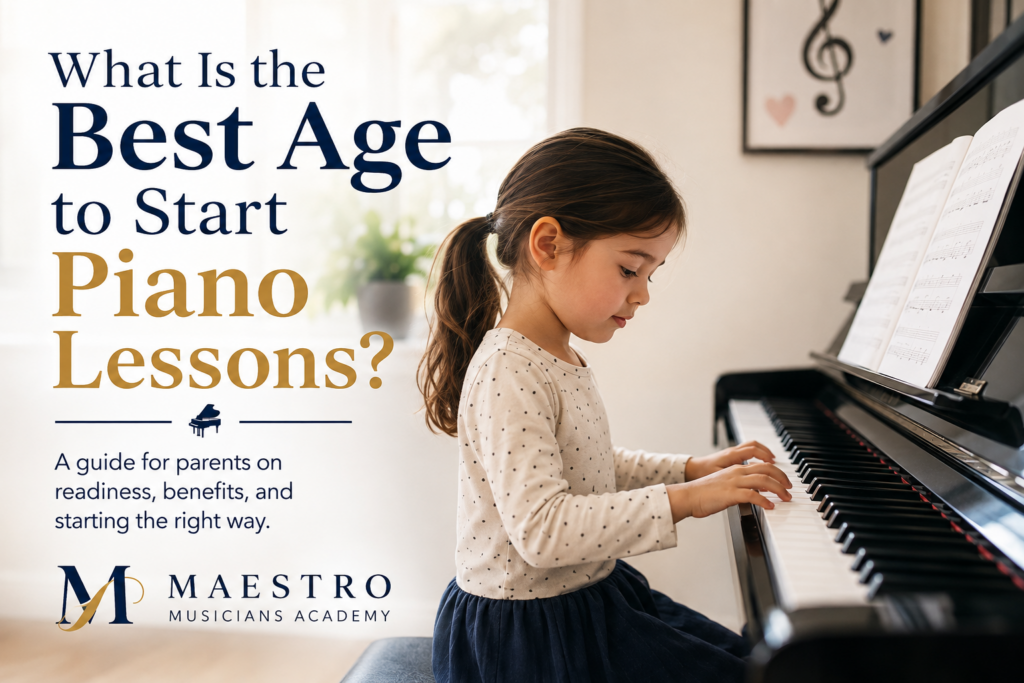
Parents often ask us, “What is the best age for my child to start piano lessons?”
It sounds like a question that should have a simple answer. But children develop at different rates, and being ready for piano lessons matters more than reaching a particular birthday.
For many children, ages 5 to 7 are an excellent time to begin formal piano lessons. Some children are ready at 4, while others will have a much better experience starting at 7, 8, or even later.
The real question isn’t simply, “How old is my child?”
It’s “Is my child ready to learn?”
Why Ages 5–7 Are Often a Great Time to Begin Piano
By around age 5 or 6, many children have developed several abilities that make traditional private piano lessons much more productive.
They can usually sit and concentrate on an activity for a reasonable amount of time. Their fine motor skills have developed enough to begin controlling individual fingers. They can understand concepts such as higher and lower, faster and slower, and same and different. They are also beginning to recognize patterns, letters, and numbers.
Just as importantly, children at this age are becoming better at listening to a teacher, following directions, and practicing something repeatedly in order to improve it.
That last skill is particularly important.
Learning the piano isn’t just about learning which keys to press. It introduces children to the process of learning a complex skill: listen, try, make a mistake, adjust, and try again.
That is one reason music lessons can be so valuable for a child’s development.
Can a 4-Year-Old Start Piano Lessons?
Absolutely—if the child is ready.
Some four-year-olds are fascinated by the piano and can happily spend time with a teacher. Others aren’t developmentally ready for a structured private lesson yet.
A young child may be ready if they can:
- Follow simple two- or three-step instructions
- Focus on an activity for several minutes
- Recognize basic patterns
- Communicate comfortably with an adult teacher
- Show genuine curiosity about music
- Accept gentle correction without becoming overly frustrated
Lessons for a four-year-old should not look exactly like lessons for an eight-year-old.
A good teacher will use shorter activities, movement, singing, imitation, musical games, and plenty of repetition. The goal is not to race through a method book. The goal is to build musical understanding, listening skills, coordination, and a positive relationship with music.
What If My Child Is 7, 8, or 9? Is That Too Late?
Not at all.
In fact, older beginners often progress very quickly.
A seven-, eight-, or nine-year-old generally has a longer attention span, stronger reading skills, better coordination, and a greater ability to understand abstract ideas. A concept that might take considerable time for a preschooler to master can sometimes be understood almost immediately by an older child.
There is no prize for starting piano at the youngest possible age.
Starting earlier only helps when the experience is appropriate for the child. A motivated eight-year-old with an excellent teacher can make far more progress than a four-year-old who isn’t ready.
And children who begin at 10, 11, 12, or during the teenage years can absolutely become accomplished pianists.
How Do I Know If My Child Is Ready?
Instead of focusing exclusively on age, look for a few signs of readiness.
Your child doesn’t need to demonstrate all of them before starting lessons, but they can help you decide whether now is a good time.
1. Your child is interested in music.
Does your child gravitate toward a piano or keyboard? Do they sing frequently, notice music in movies, or try to figure out melodies?
Interest is a powerful starting point.
2. Your child can work with an adult independently.
A private music lesson requires a relationship between the student and teacher. Your child should be able to listen, respond, and participate without needing a parent to direct every interaction.
3. Your child can tolerate repetition.
Learning an instrument requires doing things more than once.
Children don’t need extraordinary patience when they begin, but they do need to be gradually capable of hearing, “Good! Let’s try that one more time.”
4. Your family can support a practice routine.
Young children usually won’t practice consistently on their own—and we shouldn’t expect them to.
Parents play an important role in establishing a routine and helping practice become a normal part of family life.
Even 10–15 focused minutes a day can be enormously valuable for a young beginner when the practice is consistent and purposeful.
Does My Child Need a Piano Before Starting Lessons?
Your child needs regular access to an instrument at home, but you don’t necessarily need to purchase an expensive acoustic piano before the first lesson.
A good-quality digital piano can work very well for beginners.
Ideally, it should have 88 full-size weighted keys and a sustain pedal. Weighted keys are important because they help children develop the finger control and technique needed to play an acoustic piano.
Small, unweighted keyboards can be fun for musical exploration, but they are not ideal as a long-term practice instrument for a student taking formal piano lessons.
What Matters More Than Starting Age?
The quality of the child’s first musical experiences.
A wonderful teacher does much more than explain notes and rhythms. The teacher learns how a particular child thinks, what motivates them, when to challenge them, and when to slow down.
Children should certainly experience accomplishment and enjoyment in music lessons. But lessons should also teach them that worthwhile things sometimes require patience.
A difficult measure may take ten tries.
Two hands may refuse to cooperate at first.
A piece may sound awkward before it sounds beautiful.
Then, gradually, something changes.
The child discovers that persistence works.
That lesson extends far beyond the piano.
Music Is a Language
At Maestro Musicians Academy, we believe music should be taught as more than a collection of songs.
Music is a language.
Children learn to hear patterns, understand rhythm, recognize musical structure, communicate ideas, and eventually interpret music with increasing independence.
Just as children develop spoken language gradually, musical understanding develops through listening, imitation, repetition, reading, and expression.
The goal isn’t simply to teach a child to press the correct keys.
It is to help the child become a musician.
So, What Is the Best Age to Start Piano Lessons?
For many children, ages 5–7 provide an ideal window for beginning private piano lessons.
But there is no single perfect age.
A musically curious four-year-old may be ready. A six-year-old may be an ideal beginner. An eight-year-old may progress remarkably quickly. And a teenager—or an adult—can begin piano and develop a lifelong relationship with music.
Instead of asking whether your child has reached the “right” age, ask:
Can my child listen, engage with a teacher, follow simple instructions, and begin developing a small but consistent practice habit?
If the answer is yes, it may be time to begin.
At Maestro Musicians Academy, our teachers meet students where they are developmentally while helping them grow in musicianship, confidence, patience, and independence.
Because the purpose of music education isn’t simply to start early.
It’s to start well—and to build a relationship with music that can last a lifetime.