
Does Learning Music Really Make Children Smarter?
It’s one of the most common claims made about music education:
“Learning an instrument makes children smarter.”
As a music educator, I would love to tell parents that signing their child up for piano or violin lessons will automatically raise their IQ, improve their math grades, and turn them into a better student.
But the truth is more interesting than that.
Music lessons are not a magic shortcut to intelligence. What they do offer children is something potentially more valuable: regular practice using many of the mental, emotional, and physical skills that help children learn.
What Happens When a Child Learns Music?
Think about what happens during even a simple piano lesson.
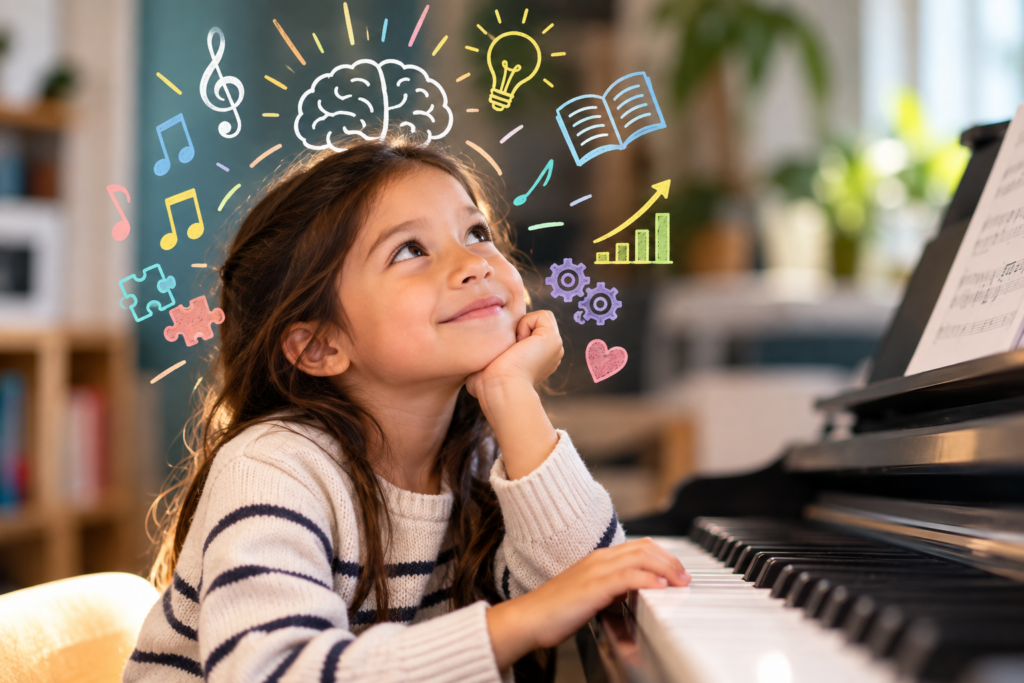
A child looks at symbols on a page. They translate those symbols into physical movements. They listen to the sound they produce. They compare that sound with what they expected to hear. They notice a mistake, determine what went wrong, and try again.
And they do all of this while keeping a steady beat, remembering instructions, controlling their fingers, and expressing something musically.
That is an extraordinary amount of mental activity packed into a seemingly simple task.
Learning music engages attention, memory, listening, coordination, pattern recognition, and self-monitoring. As music becomes more difficult, children must increasingly plan ahead, solve problems, and sustain concentration over longer periods of time.
Those abilities matter far beyond the music room.
So Does Music Increase IQ?
This is where we have to be careful.
Researchers have found associations between musical training and a variety of cognitive abilities. Some studies have also found modest cognitive benefits associated with music education.
But that does not mean we can say that music lessons simply “make children smarter.”
Children who study music may differ from children who don’t in many ways. Their families may have different resources, educational priorities, or opportunities. And while researchers can design studies to account for some of these differences, separating cause from correlation is difficult.
The strongest case for music education isn’t that playing Mozart somehow transforms a child’s brain into a mathematical supercomputer.
It is that learning music gives children repeated opportunities to practice how to learn.
Music Teaches Children to Pay Attention
Learning an instrument requires a particular kind of attention.
A teacher might ask a student:
“Did you hear what happened in the third measure?”
At first, the child may have no idea.
So they play it again.
This time they listen more carefully.
Eventually they hear it themselves.
That moment is important. The teacher hasn’t simply corrected a wrong note. The child has learned to direct their attention toward something they previously didn’t notice.
Over months and years, music lessons contain thousands of moments like this.
Children learn to listen more carefully, notice patterns, monitor their own performance, and make increasingly subtle distinctions.
Music Develops Memory
Musicians constantly use different forms of memory.
A child may need to remember what a symbol means, recall the fingering for a passage, remember what their teacher said several minutes earlier, anticipate what comes next in the music, or eventually perform an entire piece from memory.
But the deeper lesson isn’t simply remembering more things.
Children begin learning how to remember.
They discover that breaking a difficult passage into smaller sections works better than playing the whole piece repeatedly. They recognize patterns. They connect new information with things they already know.
Those are learning strategies that can serve children throughout their education.
Music Builds Problem-Solvers
One of the most important changes we hope to see in a young musician is the transition from:
“I can’t do this.”
to:
“I can’t do this yet. What should I try?”
Suppose a student repeatedly misses the same passage.
They can slow it down.
Play only the right hand.
Clap the rhythm.
Practice two measures instead of eight.
Change the fingering.
Listen carefully.
Try again.
The child gradually learns that difficulty is not necessarily a signal to stop.
It is a problem to investigate.
That mindset may ultimately be one of the most valuable things music teaches.
Music Also Teaches Something Intelligence Tests Don’t Measure
When parents ask whether music makes children smarter, I sometimes think we’re asking too narrow a question.
What about patience?
What about confidence?
What about persistence?
What about learning to accept correction without becoming discouraged?
What about discovering that something which seemed impossible three months ago is now easy?
A child who learns an instrument experiences a powerful cycle:
Challenge → effort → improvement → confidence → greater challenge.
Over time, children begin to understand that ability isn’t simply something they either possess or don’t possess.
It can grow.
The Goal Isn’t to Create a Smarter Child
At Maestro Musicians Academy, we don’t believe the primary purpose of music education is producing higher test scores.
Music deserves better than that.
Music is a language, an art form, a means of expression, and part of our shared human culture.
But learning that language also asks something remarkable of a child.
It asks them to listen.
To concentrate.
To remember.
To coordinate.
To solve problems.
To tolerate frustration.
To practice patiently.
To express themselves.
And, eventually, to stand in front of another human being and say through music:
“This is what I have learned to do.”
So, does learning music make children smarter?
The scientific answer is more nuanced than the slogan.
But after teaching and observing thousands of music lessons, I believe there is an even more important question:
What kind of person does a child become through the process of learning something difficult and beautiful?
That’s where the real value of music education begins.