

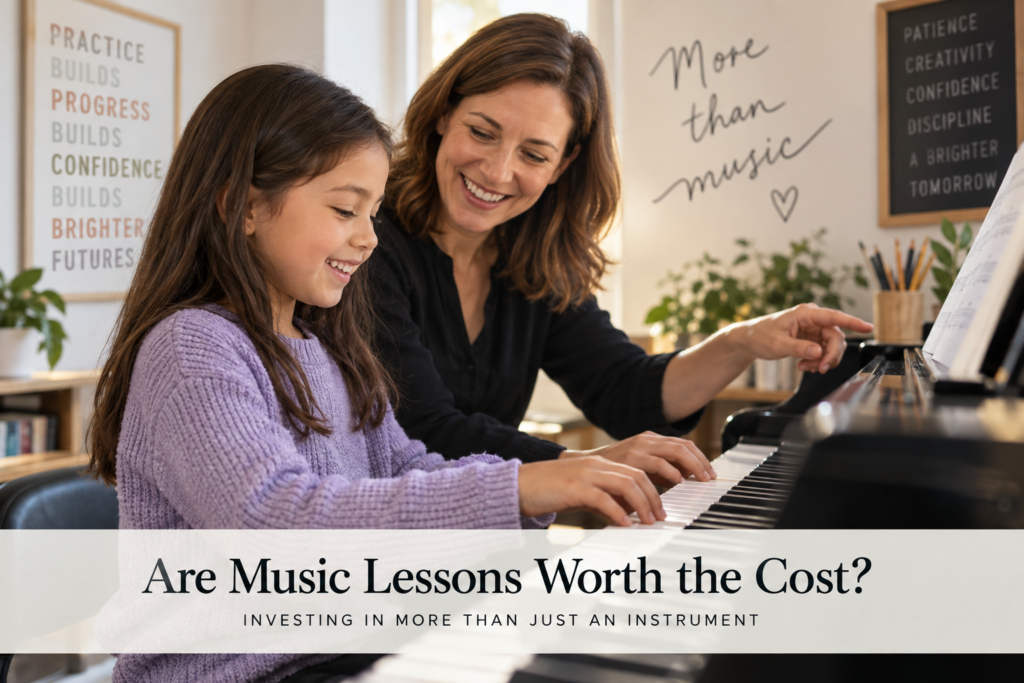
Are Music Lessons Worth the Cost?
Are Music Lessons Worth the Cost?
It’s a fair question.
Music lessons are not inexpensive. For many families, they represent a significant monthly commitment, especially when added to sports, camps, tutoring, school activities, and everything else that comes with raising children.
So are music lessons actually worth the cost?
We believe they can be. But perhaps not for the reason you might expect.
You’re Not Just Paying for a Child to Learn an Instrument
When parents imagine music lessons, it’s easy to focus on the obvious result:
My child will learn to play the piano.
Or the violin. Or guitar. Or drums.
And of course, that matters. A good music education should teach children to play their instruments well.
But if that were the only benefit, it would be reasonable to wonder whether years of lessons were worth the investment (particularly if your child has no intention of becoming a professional musician).
The deeper value of music education is what happens while a child is learning to play.
A child encounters something difficult.
They can’t do it yet.
They try. They struggle. They receive guidance. They practice. They improve.
And eventually, something that once seemed impossible becomes something they can do.
That experience is enormously valuable.
Music Teaches Children How to Work at Something
Children live in a world that increasingly offers immediate results.
Tap a screen. Get an answer.
Watch a video. Skip ahead.
Music doesn’t work that way.
Learning an instrument requires patience. A difficult passage may take days or weeks to master. Progress isn’t always obvious from one lesson to the next.
Children gradually learn an important lesson:
Not being able to do something today doesn’t mean I won’t be able to do it tomorrow.
That is bigger than music.
It is the beginning of persistence.
Music Gives Children a Different Kind of Confidence
There is a difference between telling a child, “You’re amazing!” and allowing a child to discover:
“I can do hard things.”
Music provides opportunities for that discovery again and again.
The first time a child plays a song from beginning to end.
The first time they perform for someone else.
The moment they finally master something that frustrated them for weeks.
Those experiences build confidence based on evidence.
The child doesn’t simply hear that they are capable.
They experience it.
Music Develops Attention in a Distracted World
Playing music requires an unusual kind of concentration.
A student may need to listen to pitch, rhythm, articulation, dynamics, balance and tone, while simultaneously coordinating their hands and reading musical notation.
Over time, students learn not simply to hear, but to notice.
They begin recognizing details they previously missed.
That ability to slow down, listen carefully and sustain attention has value far beyond the music studio.
The Teacher Matters
Of course, simply enrolling a child in music lessons doesn’t guarantee any of this.
The quality of the experience matters enormously.
A good teacher doesn’t simply point out wrong notes.
A good teacher learns how a particular child thinks.
When should the teacher challenge?
When should the teacher encourage?
When should they insist on greater attention to detail?
When should they change their approach because the student isn’t understanding?
Teaching children well requires both musical expertise and an understanding of how children learn.
That relationship is a significant part of what families are investing in when they choose private music instruction.
What If My Child Doesn’t Become a Musician?
Most children who take music lessons will not become professional musicians.
That’s okay.
We don’t teach children to read because we expect them to become novelists.
We don’t encourage children to play sports because we expect them to become professional athletes.
Some experiences are worthwhile because of the people they help children become.
A child who studies music may eventually become a physician, engineer, teacher, entrepreneur, scientist — or something none of us can predict today.
But the patience required to master a difficult passage, the courage required to perform, the sensitivity required to listen and the discipline required to improve can travel with them.
So, Are Music Lessons Worth the Cost?
The better question may be:
What do you hope your child gains from the experience?
If the goal is simply to keep a child occupied for 30 or 45 minutes each week, there are certainly less expensive ways to do that.
But music education can offer something much deeper.
It can give children a lifelong relationship with music.
It can teach them to listen.
To persist.
To express themselves.
To tolerate frustration.
To notice beauty.
And perhaps most importantly, it can give them repeated experiences of discovering that something difficult can become possible through patience, guidance and effort.
That is why we believe music lessons are worth investing in.
Not because every child should become a musician.
But because every child deserves opportunities to discover what they are capable of becoming.