

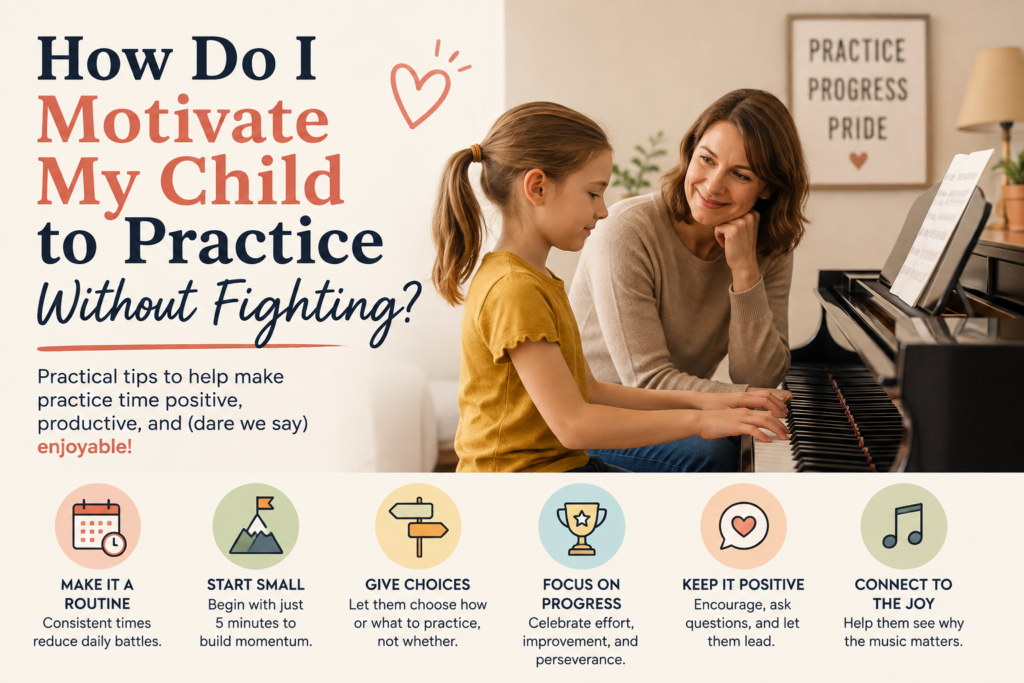
How Do I Motivate My Child to Practice Without Fighting?
It’s 6:30 p.m. You remind your child that it’s time to practice.
“I don’t want to.”
You remind them again.
“Later.”
Ten minutes later, you ask a third time. Now everyone is frustrated. Eventually your child sits down at the instrument—but by then, nobody is in the mood for music.
If this sounds familiar, you’re not alone.
One of the most common questions parents ask music teachers is: “How do I get my child to practice without having to fight about it every day?”
The answer usually isn’t to push harder. And it isn’t to give up and wait for your child to become motivated on their own.
The goal is to gradually make practicing a normal part of family life while helping children develop something much more valuable than obedience: the ability to persist when something is difficult.
First, Understand Why Your Child Doesn’t Want to Practice
When a child resists practicing, adults sometimes assume the problem is motivation.
But “I don’t want to practice” can mean many different things:
- “This is hard.”
- “I don’t know what I’m supposed to do.”
- “I’m tired.”
- “I’m afraid I’m going to get it wrong.”
- “I’d rather be doing something that gives me an immediate reward.”
- “I’ve been practicing the same thing and I don’t hear myself improving.”
That distinction matters.
A child who is confused needs clarity. A child who is overwhelmed needs a smaller task. A child who is bored may need a new challenge. And a child who is simply testing a boundary may need a calm, consistent routine.
Before trying to increase motivation, figure out what is getting in its way.
Don’t Ask, “Do You Want to Practice?”
Imagine asking your child every morning, “Do you feel like brushing your teeth today?”
We don’t usually treat basic routines as daily negotiations. Practicing can eventually work the same way.
Instead of:
“Do you want to practice now?”
Try establishing a predictable time:
“We practice after snack.”
Or:
“Piano happens before screen time.”
This removes an enormous source of conflict: the decision itself.
Children generally do better when they know what to expect.
If practice happens at roughly the same time each day, it gradually becomes less of an event and more of a routine.
Make Starting Ridiculously Easy
Sometimes the hardest part of practicing is simply beginning.
If your child is resisting, don’t start by demanding 30 minutes of concentrated work.
Try:
“Let’s just do five minutes.”
Or even:
“Play that tricky measure three times.”
Once children begin, they will often continue.
And if they don’t? Five focused minutes can still be more valuable than 30 minutes spent arguing about practicing.
Consistency comes first. Duration can grow later.
Give Choices—but Not About Whether to Practice
Children need some sense of ownership.
Instead of giving them control over whether they practice, give them control over how they practice.
For example:
“Would you like to start with your piece or your scale?”
“Do you want to practice before dinner or after dinner?”
“Which piece should we finish with today?”
These are real choices, but the expectation remains intact.
This is particularly helpful for children who instinctively resist being told what to do.
Break Difficult Music Into Tiny Victories
One of the biggest mistakes young musicians make is starting at the beginning of a piece and playing until the end.
That may feel like practicing, but it often means repeatedly playing the easy parts and repeatedly struggling with the hard ones.
Instead, teach children to become musical detectives.
Find the difficult spot.
Play two measures slowly.
Repeat them three times.
Fix one rhythm.
Practice one shift.
Then celebrate the improvement.
A child who hears something getting better begins to understand an incredibly important lesson:
“I couldn’t do this five minutes ago. Now I can.”
That feeling is one of the most powerful sources of motivation we can give a young musician.
Don’t Turn Every Practice Session Into a Critique
Parents naturally want to help.
Unfortunately, sitting nearby and saying:
“That’s the wrong note.”
“Slow down.”
“Your teacher told you to use a different fingering.”
“You’re rushing again.”
can quickly transform practice into a daily evaluation.
Instead, try asking questions.
“What part do you think improved?”
“Which measure is giving you trouble?”
“What did your teacher ask you to work on?”
Or simply:
“Can I hear what you’ve been working on?”
The goal is to help children gradually take responsibility for listening to themselves.
Make the Boring Stuff Sound Like Music
Scales, exercises, and technical studies are important—but children don’t always understand why.
A good teacher can help technical work feel connected to actual music.
A scale can become a speed challenge.
A bowing exercise can become a rhythm game.
A piano pattern can sound like the beginning of a composition.
An étude can be chosen because it actually sounds exciting.
Children are much more likely to practice technical material when they understand what
skill it is building and can hear its connection to the music they want to play.
Praise the Process, Not Just the Performance
“Wow, you’re so talented!” feels encouraging.
But there is an even more useful kind of praise:
“You kept working on that even when it was frustrating.”
Or:
“I heard how much better that passage became after you slowed it down.”
Or:
“You didn’t know how to play that last week. Look what happened because you practiced it.”
This directs a child’s attention toward persistence, problem-solving, patience, and improvement.
Those qualities matter far beyond music.
Sometimes You Should Stop
There is also a point where productive practice becomes counterproductive.
If your child is exhausted, crying, or completely dysregulated, another 20 minutes at the instrument
probably isn’t teaching perseverance.
It may simply be teaching them to associate music with conflict.
End the session. Try again tomorrow.
Consistency over months and years matters far more than winning one battle on a Tuesday night.
Your Child Does Not Need to Love Practicing Every Day
This may be the most important point.
Adults sometimes assume that if a child truly loves music, they should naturally want to practice.
That’s unrealistic.
Children who love soccer don’t necessarily love every drill. Children who love reading don’t necessarily enjoy every homework assignment.
Professional musicians don’t wake up every morning thrilled to practice scales.
Learning to do something worthwhile even when we don’t particularly feel like doing it is part of growing up.
Music gives children a remarkably safe place to learn that lesson.
The Long-Term Goal Is Independence
When children are young, parents provide much of the structure.
Over time, that responsibility should gradually transfer to the student.
The progression might look something like this:
Parent reminds → parent helps organize → child practices with occasional reminders
→ child plans practice independently.
That transition takes years, not weeks.
And that’s okay.
The ultimate goal isn’t to produce a child who practices because Mom or Dad won an argument.
It’s to raise a young person who can sit down in front of something difficult and think:
“I don’t know how to do this yet—but I know how to work on it.”
That is one of the greatest gifts music education can give a child.
Music Lessons That Build More Than Musical Skills
At Maestro Musicians Academy, we believe music lessons should develop the whole child.
Our teachers help students build confidence, patience, resilience, independence, and a genuine relationship with music—not simply prepare for the next piece or recital.
And when practicing becomes difficult, we work with both students and parents to find strategies that fit the individual child.
Because the goal isn’t just to create better musicians.
It’s to help children discover what they are capable of becoming.