

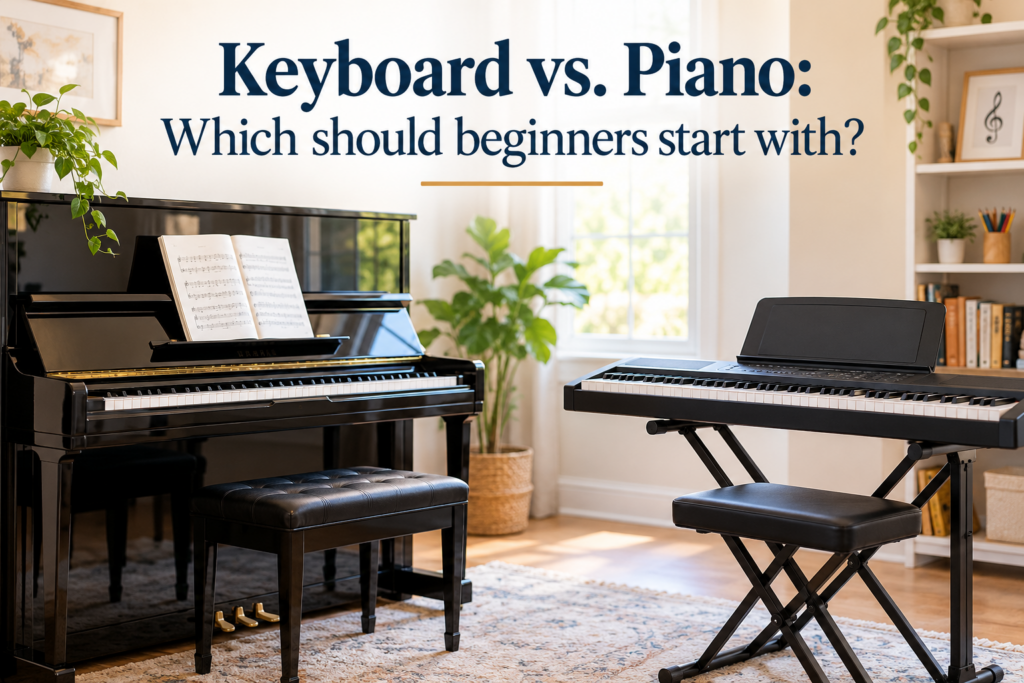
Keyboard vs. Piano: Which Should Beginners Start With?

Your child is excited to begin piano lessons. Wonderful! But before that first lesson, there’s an important decision to make: Should you purchase an acoustic piano or start with an electronic keyboard?
For many families, this is one of the first questions that comes up when considering piano lessons. Acoustic pianos can be expensive, while electronic keyboards are often more affordable and convenient. Does it really matter which instrument your child uses?
The short answer is yes, but you don’t necessarily need an expensive acoustic piano to get started.
Let’s explore the differences between acoustic pianos, digital pianos, and electronic keyboards so you can make the right decision for your family.
1. What’s the difference between a piano and a keyboard?
Although they may look similar, acoustic pianos and electronic keyboards produce sound in fundamentally different ways.

Acoustic pianos
An acoustic piano produces sound when hammers strike strings inside the instrument. The pianist controls the volume and character of each note through the weight and speed of their touch.
Acoustic pianos offer a rich range of expression and a physical connection between the pianist and the instrument.

Digital pianos
Digital pianos use electronic technology to reproduce the sound and feel of an acoustic piano. Many have 88 weighted keys designed to simulate the resistance of an acoustic piano’s keyboard.
A quality digital piano can be an excellent alternative for beginners, especially when space, cost, or noise is a concern.

Electronic keyboards
Portable electronic keyboards are generally smaller and less expensive. Many have 61 or 76 keys rather than the full 88 found on traditional pianos.
They frequently include hundreds of sounds, built-in rhythms, and other entertaining features. However, inexpensive models often lack weighted keys, which can make developing proper piano technique more challenging.
2. Why does the type of instrument matter?
Learning to play the piano involves much more than pressing the correct keys. Students gradually develop finger independence, coordination, control, musical expression, and the ability to produce different dynamics.
The instrument they practice on can influence how these skills develop.
For example, acoustic pianos and quality digital pianos respond to variations in touch. A student can learn to produce a gentle melody with one hand while playing a softer accompaniment with the other.
An inexpensive keyboard with unweighted keys may not provide the same physical feedback.
This doesn’t mean children cannot learn music on a keyboard. They absolutely can! However, students who practice exclusively on inexpensive keyboards may need time to adjust when they eventually transition to an acoustic piano.
3. Is an acoustic piano always the best choice?

An acoustic piano offers an authentic playing experience, but that doesn’t automatically make it the most practical choice for every family.
Acoustic pianos have several advantages. They provide a natural touch, a wide range of tonal possibilities, and the opportunity for students to develop sensitivity to the instrument’s response.
They also have some disadvantages. Acoustic pianos are relatively expensive, require periodic tuning and maintenance, occupy considerable space, and cannot be played silently.
For families living in apartments or households where children practice while others are working or sleeping, these considerations can be significant.
A well-maintained acoustic piano is a wonderful investment for a committed student. However, families should not feel obligated to purchase one before their child has even taken a first lesson.
4. Why a digital piano may be the ideal compromise
For many beginning students, a quality digital piano offers an excellent balance between affordability, convenience, and educational value.
Unlike inexpensive portable keyboards, digital pianos are specifically designed to reproduce the playing experience of an acoustic piano.
Look for these features when shopping:
-
88 full-size keys: This provides the same keyboard range as a traditional acoustic piano.
-
Weighted, touch-sensitive keys: These help students develop finger control and learn to produce different dynamics.
-
A sustain pedal: This becomes increasingly important as students progress.
-
A sturdy stand and adjustable bench: Proper seating and instrument height encourage healthy playing habits.
-
A headphone connection: This allows students to practice without disturbing the rest of the household.
Digital pianos also have the advantage of never requiring tuning.
One important distinction: Not all digital instruments are created equal. A keyboard advertised as having touch-sensitive keys is not necessarily equipped with weighted keys.
Whenever possible, choose an instrument with a weighted, hammer-action keyboard.
5. Can my child start with an inexpensive keyboard?
Absolutely. In fact, if purchasing an expensive instrument would prevent your child from beginning lessons altogether, starting with an affordable keyboard may be the right decision.
A portable keyboard can introduce children to note reading, rhythm, hand coordination, and basic musical concepts.
However, there are some limitations.
Many inexpensive keyboards have fewer keys, lack realistic resistance, and provide limited control over dynamics. These limitations become increasingly noticeable as students advance.
If your child begins with a portable keyboard, consider treating it as a temporary solution rather than a permanent replacement for a piano.
The important thing is to choose an instrument that allows your child to practice consistently while planning for an upgrade when appropriate.
6. How much should families expect to spend?
Your budget will naturally influence your decision. Fortunately, there are options at several price points.
The following are approximate price ranges for new instruments, although used instruments may cost considerably less.
| Instrument | Approximate price |
|---|---|
| Basic portable keyboard | $100–$300 |
| Entry-level digital piano | $400–$800 |
| Intermediate digital piano | $800–$2,000 |
| New acoustic upright piano | $4,000–$12,000+ |
| New acoustic grand piano | $10,000–$30,000+ |
A used acoustic piano can sometimes be an excellent bargain. However, we strongly recommend having a qualified piano technician inspect any used piano before purchasing it.
A piano advertised as free may ultimately cost hundreds or even thousands of dollars in moving, tuning, or repairs.
Remember that a more expensive instrument doesn’t automatically translate into better musical progress. A suitable instrument, consistent practice, and an excellent teacher are much more important.
7. Which instrument should your child start with?
Our recommendations for beginners
Choose an instrument that supports your child’s learning and fits your family’s circumstances.
An 88-key weighted digital piano
This offers a practical combination of realistic touch, affordability, and convenience. It’s an excellent starting point for families who aren’t ready to invest in an acoustic piano.
A quality acoustic piano
If you have the budget, space, and commitment, an acoustic piano provides a wonderful foundation for musical development.
A touch-sensitive portable keyboard
If this is what your family can afford right now, don’t let the instrument prevent your child from discovering music. Just recognize that an upgrade may eventually become necessary.
8. The most important ingredient isn’t the instrument
There’s one final consideration that parents sometimes overlook.
A beautiful piano sitting untouched in the living room provides very little educational value.
Meanwhile, a child who practices regularly on a modest digital piano, receives thoughtful instruction, and develops a genuine love of music can make tremendous progress.
The relationship between a student and their teacher is particularly important. An excellent teacher helps children develop technical skills while nurturing curiosity, confidence, creativity, and perseverance.
Ultimately, our goal shouldn’t simply be to teach children which keys to press. It should be to help them discover the joy of making music and develop skills and character traits that will serve them throughout their lives.
Ready to begin your child’s musical journey?
At Maestro Musicians Academy, we believe music education is about much more than learning an instrument. Through meaningful relationships between teachers and students, we help children develop confidence, character, and a lifelong appreciation for music.
Whether you already own a piano or are considering purchasing your child’s first keyboard, our teachers can help you get started.
We offer personalized piano lessons for children and adults, from complete beginners to advanced students.
Explore our piano lessons and schedule a trial lesson
Your child’s musical journey doesn’t need to begin with the perfect instrument. It begins with the opportunity to discover what music can bring to their life.