
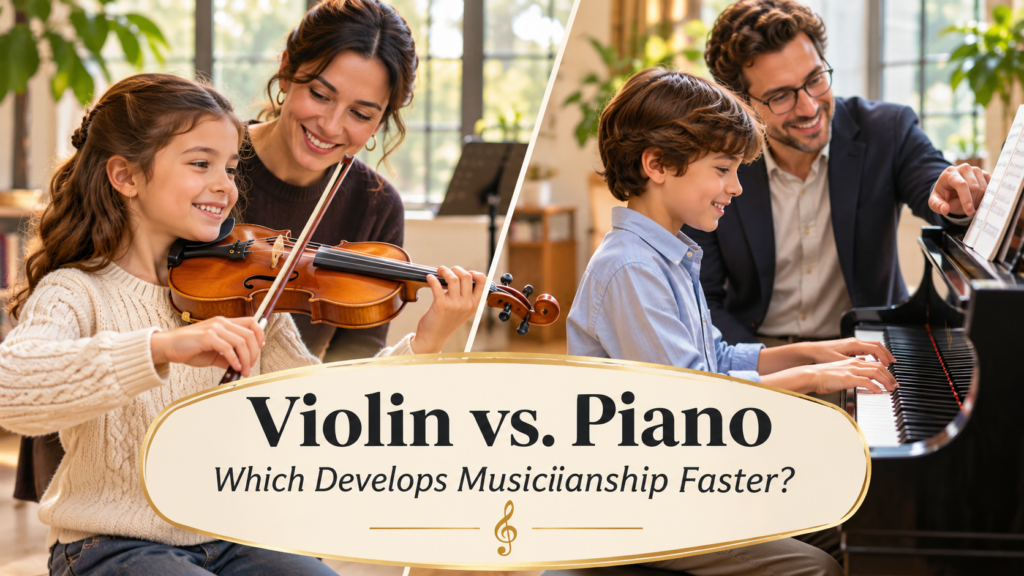
Violin vs. Piano: Which Develops Musicianship Faster?
Piano often provides a quicker introduction to notes, melodies, and musical relationships, while violin demands especially close attention to pitch and tone from the beginning. Neither instrument, however, has been proven to develop overall musicianship faster for every child.
What Is Musicianship?
Musicianship means much more than playing the correct notes. It includes several interconnected abilities:
- Rhythm: Feeling and maintaining a steady beat.
- Pitch recognition: Hearing differences between notes and recognizing when something sounds in tune.
- Music reading: Understanding written musical notation.
- Musical expression: Communicating emotion through phrasing, dynamics, and tone.
- Coordination: Developing the physical control necessary to perform music.
- Musical understanding: Recognizing melodies, harmonies, and musical structures.
Both instruments develop these skills, but they emphasize different ones in the early stages.
Why Piano Often Provides a Faster Start
One of the piano’s greatest advantages is its visual organization. The keyboard presents notes in a clear, repeating pattern, helping students see the relationship between higher and lower pitches, intervals, and chords.
A properly tuned piano also produces a dependable pitch whenever a key is pressed. Beginners can therefore concentrate on rhythm, reading, and familiar melodies without having to adjust each note’s intonation.
1. Early musical satisfaction
Beginning piano students can often learn recognizable melodies relatively quickly. That early success may help children feel motivated to continue.
2. A visual introduction to music theory
Scales, chords, and intervals are easy to demonstrate on a keyboard. As students progress, playing different notes in each hand gives them direct experience with melody and harmony together.
3. A broad foundation for reading music
Piano students commonly learn both treble and bass clefs, introducing them to a wide range of written pitches.
Of course, piano is not easy. Independent hand coordination, fluent sight-reading, and expressive playing can take years to master. Its advantage is that many basic musical ideas are accessible from the beginning.
Why Violin Places Greater Demands on Listening
The violin presents a different challenge: unlike the piano, it has no keys or frets that identify exactly where every finger should go. Students must learn to place their fingers accurately and listen closely to the resulting pitches.
They also need to coordinate the bow, the left hand, and their posture to produce a clear sound.
1. Continuous attention to pitch
Even small changes in finger placement can affect intonation. Violin students therefore practice listening for pitch accuracy and making corrections from the outset.
2. Sensitivity to tone and expression
Bow speed, pressure, placement, and articulation all influence the violin’s sound. As students develop, they learn how to shape individual notes and musical phrases.
3. Opportunities for ensemble playing
Orchestras and chamber groups give violin students opportunities to develop rhythmic precision and attentive listening to other performers.
The trade-off is a steeper initial learning curve. Producing a beautiful tone and reliable intonation may take longer than playing the first simple tunes on a piano.
Violin vs. Piano: A Side-by-Side Comparison
| Musical Skill | Piano | Violin |
|---|---|---|
| Early recognizable melodies | Often easier | Usually more technically demanding |
| Visualizing notes | Clear keyboard layout | Finger positions are less visibly marked |
| Pitch accuracy | Instrument supplies each pitch | Player continually adjusts finger placement |
| Learning harmony | Chords can be played directly | Usually explored through additional activities |
| Tone control | Touch, articulation, and pedaling | Bowing and articulation |
| Ensemble experience | Accompaniment and chamber music | Orchestra and chamber music |
These are general differences in how the instruments are learned—not rankings of which creates a better musician.
What Does Research Tell Us?
Research on instrumental instruction suggests that music study can support auditory, motor, and other skills. However, that is different from proving that one beginner instrument produces faster overall musical development than another.
There is no widely established scientific consensus that violin or piano universally develops musicianship faster. Progress depends on the individual student, the quality of instruction, the way lessons are structured, and practice habits.
The most defensible conclusion is that each instrument emphasizes different aspects of musicianship, especially during the beginner years.
Which Instrument Is Better for Your Child?
The best choice depends on your child’s interests and temperament, not just the speed of early progress.
Piano may appeal to a child who:
- Enjoys visual patterns and exploring how things fit together.
- Wants to play familiar melodies relatively quickly.
- Is interested in composing or improvising.
- Likes the sound and musical possibilities of the piano.
Violin may appeal to a child who:
- Loves the sound of string instruments.
- Looks forward to participating in an orchestra.
- Enjoys careful, hands-on challenges.
- Is excited about learning to shape a singing, expressive tone.
These are starting points, not fixed rules. An enthusiastic violin student may thrive even if piano seems easier at first—and the reverse is equally true.
Does Your Child Need to Learn Piano Before Violin?
No. Children do not need to study piano before learning violin. A well-structured violin curriculum can teach reading, rhythm, listening, and theory from the beginning.
Similarly, piano students can build strong listening skills through singing, ear training, improvisation, and thoughtful practice. Studying both instruments can be rewarding, but it is not required to become a well-rounded musician.
Why the Teacher Matters
Good teaching goes beyond correcting notes. An effective music teacher helps students listen critically, establish productive practice habits, and communicate musical ideas.
A piano teacher might ask a student to sing a melody before playing it; a violin teacher might reinforce rhythm and notation while guiding bowing and intonation. In either case, technical skills and musical understanding should grow together.
At Maestro Musicians Academy, we believe that learning an instrument should mean more than working through a sequence of pieces. Our aim is to help students become thoughtful, expressive, and confident musicians.
The Verdict: Which Develops Musicianship Faster?
For a quick introduction to notes, basic melodies, and harmony, piano often has the advantage. For the immediate demands of pitch adjustment and bow-controlled tone, violin presents distinctive listening and coordination challenges.
Neither advantage proves that one instrument develops overall musicianship faster. A motivated child with an effective teacher and consistent practice can make excellent progress on either instrument.
Rather than asking only, “Which instrument develops musicianship faster?” consider asking: “Which instrument will make my child want to keep learning and making music?”