
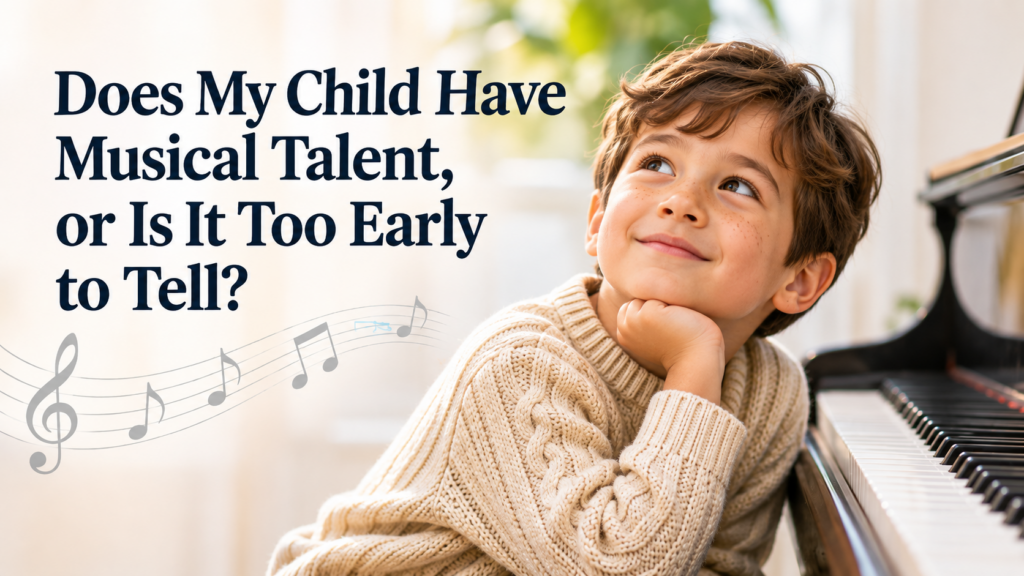
Does my child have musical talent, or is it too early to tell?
How to recognize your child’s musical potential, why natural talent isn’t everything, and when to consider music lessons.

Your child sings along to every song in the car. They tap rhythms on the kitchen table, dance whenever music comes on, or seem fascinated by the piano at a friend’s house.
You start to wonder: Does my child have a natural gift for music?
Or perhaps your experience is the opposite. Your child loves music but struggles to sing in tune, can’t clap to a steady beat, or shows little obvious musical ability. Does that mean music lessons would be a waste of time?
The answer to both questions may surprise you. Musical talent can reveal itself early, but a child’s potential is much more complicated than whether they can sing beautifully or play a tune on their first try.
For most children, the best way to discover their abilities is to give them opportunities to explore music rather than waiting for talent to announce itself.
What Does Musical Talent Actually Mean?
When parents think of musical talent, they often picture a child who can sit down at a piano and immediately play a melody, or a young violinist who learns everything effortlessly.
But musical aptitude includes several different skills:
- Pitch recognition: Hearing differences between notes and recognizing melodies.
- Rhythmic awareness: Feeling a steady beat and recognizing rhythmic patterns.
- Musical memory: Remembering melodies or rhythms after hearing them.
- Listening sensitivity: Noticing changes in tempo, volume, and expression.
- Musical creativity: Inventing songs, experimenting with sounds, or expressing ideas through music.
A child may be strong in one area and develop more slowly in another. A five-year-old who struggles to sing in tune might have an excellent sense of rhythm. Another child might reproduce melodies easily but need help developing coordination at the piano.
Neither child’s musical future can be predicted from that single observation.
Five Signs Children May Have Musical Aptitude
1. They remember songs easily.
They recall a melody after hearing it only a few times, or remember a tune they haven’t heard in weeks. This may indicate strong musical memory.
2. They respond naturally to rhythm.
They tap their feet, clap, dance, or move to music. Perfect timing isn’t required, especially in young children.
3. They experiment with sounds.
They make up songs, explore a keyboard, or imitate sounds they hear. Curiosity is worth encouraging.
4. They notice musical details.
They recognize when a familiar tune changes, notice instruments, or ask questions about what they hear.
5. They show sustained curiosity.
They repeatedly return to music, ask to hear favorite songs, want to try an instrument, or enjoy making music when nobody is watching. For a parent deciding whether to begin lessons, genuine interest is especially useful to notice.
None of these behaviors proves that a child is exceptionally gifted. And their absence doesn’t mean a child lacks musical potential. They’re clues worth exploring, not a formal test.
Is Musical Talent Something Children Are Born With?
Musical abilities reflect a combination of individual differences, development, and experience. Some children demonstrate unusually strong musical perception early. Others begin with more modest abilities and develop considerable skills over time.
Music education researcher Edwin Gordon distinguished between musical aptitude (potential to learn music) and musical achievement, the skills a person has already developed.
A child who has grown up surrounded by music may appear more talented than one with little musical exposure. But parents may be seeing differences in experience as well as underlying potential.
Can Music Lessons Actually Develop Talent?
Music instruction can help children develop musical skills, although the pace and extent of improvement vary. Listening, rhythm, coordination, expressive playing, and technique are all skills teachers can actively nurture.
A child who cannot match a pitch today may become a stronger singer with practice and guidance. Someone who struggles with a steady beat can improve through movement, listening, and rhythmic games. A beginning pianist can gradually develop the coordination needed to play comfortably.
Progress isn’t always immediate or consistent. But initial difficulty should not be mistaken for an inability to learn.

What If My Child Doesn’t Seem Musically Talented?
Imagine two children beginning piano lessons. The first learns melodies quickly. The second needs more repetition and progresses slowly. Which child will still be playing five years later?
We simply don’t know.
The first child may continue developing rapidly—or become frustrated when the music grows challenging. The second may develop strong practice habits, discover a personal connection with music, and continue playing for years.
Musical aptitude matters, but so do motivation, practice, instruction, family support, and the quality of the learning experience.
That’s why we encourage parents to avoid labeling children as either “musical” or “not musical.” Those labels can create unnecessary expectations for one child and discourage another before they’ve had a meaningful opportunity to learn.
At What Age Can You Tell Whether Your Child Has Musical Talent?
There’s no single birthday when musical potential suddenly becomes clear. These are broad developmental guidelines, not deadlines or diagnostic standards:
| Age | What parents might notice |
|---|---|
| 2–3 | Singing fragments of songs, moving to music, exploring sounds. |
| 4–5 | Growing ability to imitate rhythms and melodies; readiness for some structured activities. |
| 6–8 | Developing musical memory, listening skills, and coordination; following instructions. |
| 9–12 | Greater attention, technique, musical understanding, and capacity for independent practice. |
| Teens | Increasing ability to make musical choices, practice independently, and pursue advanced repertoire. |
A four-year-old may be ready for introductory private lessons, while another child of the same age may benefit more from informal musical play. An eleven-year-old who’s never touched an instrument can also be an excellent beginner.
It’s rarely too late to start developing musical skills, and there’s usually no need to determine a child’s talent before they begin.
Three Simple Ways to Explore Music at Home
You don’t need an expensive instrument or a formal test to encourage curiosity.
1. The Echo Game
Clap a simple rhythm of three or four beats and invite your child to clap it back. Take turns inventing rhythms. Notice whether they enjoy listening and trying again—not just whether they get it right.
2. Finish the Song
Sing part of a familiar song and stop before the last phrase. See whether your child can finish it, hum the tune, or identify the song. Don’t worry about perfect pitch matching.
3. Musical Detective
Play a short piece and ask whether it sounds fast or slow, loud or soft, cheerful or mysterious. Can your child identify an instrument? Let them describe music in their own words.
These activities should be fun, not tests your child must pass. One child might love musical games; another might connect through singing or trying a real instrument.
What Matters More Than Talent When Choosing Music Lessons?
At Maestro Musicians Academy, we believe one of the most important factors in a child’s musical development is finding the right teacher.
A naturally capable child can lose interest if lessons feel intimidating or disconnected from their interests. A child with no obvious musical advantage may make meaningful progress when a teacher understands how they learn, establishes realistic goals, and builds confidence alongside musical skills.
Some children thrive with a structured, detail-oriented approach. Others need more creativity, encouragement, or variety. The best fit isn’t necessarily the teacher with the most impressive performance résumé; it’s the teacher who can connect with your child and help them grow over time.

Should You Start Music Lessons If You’re Not Sure Your Child Has Talent?
If your child expresses interest in learning an instrument, lessons may be worth exploring—provided they’re developmentally ready for the format you choose.
Ask yourself:
- Does my child show curiosity about music or an instrument?
- Is he or she ready to participate in an age-appropriate lesson?
- Can our family realistically make room for lessons and manageable musical activity at home?
That third question is important for families juggling school, homework, sports, and other commitments. A good teacher can help establish expectations that fit family life.
Beginning lessons doesn’t require a lifelong commitment to becoming a professional musician. It gives your child a chance to discover whether making music can become a meaningful part of life.
The Bottom Line: Don’t Wait for Talent to Reveal Itself
Your child may turn out to have exceptional musical aptitude. They may become a capable musician through steady practice and supportive instruction. Or music may simply become something they love—a lasting source of enjoyment, creativity, and self-expression.
All three outcomes have value.
Your child doesn’t need to prove they’re talented before taking their first lesson. Sometimes, the first lesson is where the discovery begins.
Find the Right Music Teacher for Your Child
Maestro Musicians Academy offers personalized private lessons for children ages four and up in piano, violin, viola, cello, voice, guitar, and drums. We focus on understanding your child’s personality, interests, and goals to help find an appropriate teacher match.
Serving families in Lexington and Sharon, Massachusetts, and Greater Cleveland, Ohio.
Ask About Lessons & Availability
Interested in trying lessons first? Ask us about our $49 trial lesson.