Piano vs. Guitar: Which Is Better for Kids?
Choosing your child’s first musical instrument can be surprisingly difficult. Piano and guitar are two of the most popular choices, and both offer wonderful opportunities for musical development. But which one is easier to learn? Which is better for younger children? And which is more likely to keep your child interested over time?
The answer depends on your child’s age, interests, personality, and physical development.
At Maestro Musicians Academy, we encourage parents to think beyond which instrument is supposedly “better.” The real goal is to help children discover an instrument they will enjoy learning and feel motivated to practice.
Let’s compare piano and guitar to help you make an informed decision.
1. Which Is Easier for Beginners: Piano or Guitar?
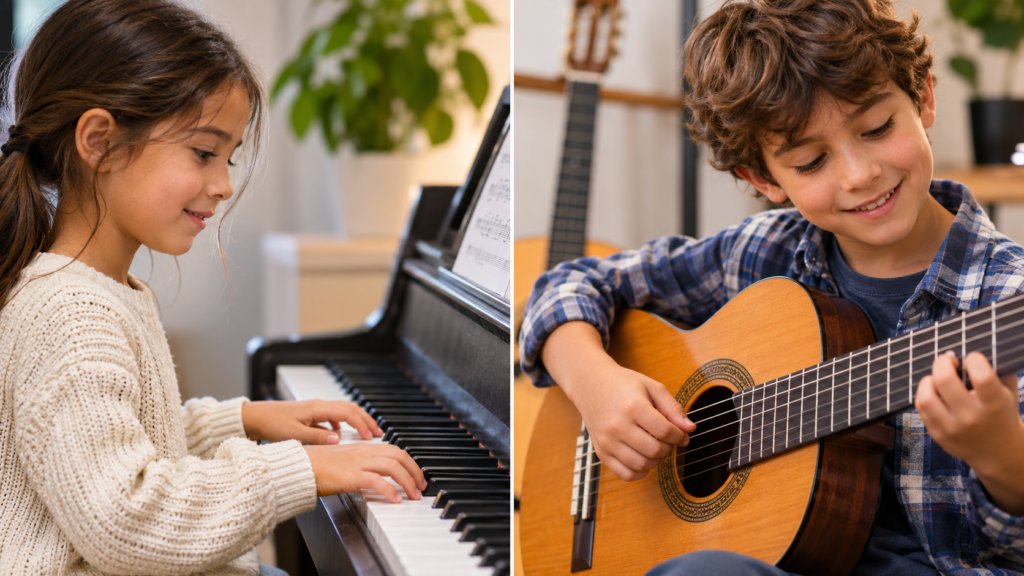
For many young beginners, piano offers an easier introduction to producing recognizable notes and melodies.
When a child presses a piano key, the instrument produces a clear, consistent pitch. The notes are arranged visually from low to high, making it relatively easy to understand how melodies work.
Guitar requires more physical coordination at the beginning. Children must press strings firmly enough to produce clean notes while using the other hand to pluck or strum. Initially, this can lead to buzzing strings, muted notes, or sore fingertips.
However, guitar offers an advantage of its own: children can eventually learn a handful of chords and use them to accompany many familiar songs.
Our perspective: Piano generally makes producing individual notes easier at first, but guitar can be equally rewarding for a child who is excited about the instrument.
2. What Is the Best Age to Start Piano or Guitar?
Although every child develops differently, piano often accommodates younger beginners more easily.
Piano: Often Ages 4–6 and Up
Children can frequently begin introductory piano lessons around age four or five, depending on their attention span and readiness.
Piano is particularly accessible because:
- A child can produce a note without developing specialized finger strength.
- The keyboard provides a clear visual layout.
- Simple melodies can be played with just a few fingers.
- Lessons can incorporate rhythm games, listening activities, and musical exploration.
Guitar: Often Ages 6–8 and Up
Many children begin guitar lessons around ages six to eight, although younger students can succeed with appropriate instruments and instruction.
Guitar requires sufficient hand coordination to press strings and move between notes. A properly sized guitar is especially important, and younger beginners may find nylon strings more comfortable than steel strings.
These ages are guidelines, not requirements. An experienced teacher can help determine whether a particular child is ready.
3. Which Instrument Is Better for Learning Music Theory?
Piano has a practical advantage when introducing many fundamental musical concepts.
The keyboard provides a visual representation of musical relationships. Children can see how notes are organized, how scales move, and how chords are constructed.
Piano students also commonly learn to read both treble and bass clefs, which can build a useful foundation for future musical study.
Guitar students learn many of the same concepts, but the fretboard organizes notes differently. The same pitch can sometimes be played in several locations, which can make the relationship between notes less visually obvious to beginners.
That does not make guitar an inferior instrument for musical education. Guitarists also study rhythm, notation, harmony, and musical structure.
The bottom line: Piano offers a particularly intuitive introduction to music theory, but either instrument can provide a strong musical education.
4. Which Instrument Will My Child Enjoy More?
This is arguably the most important consideration.
A child who loves rock, folk, or popular music may be drawn to the guitar. The opportunity to strum favorite songs, accompany singing, or eventually play with friends can be enormously motivating.
A child who enjoys movie soundtracks, classical music, composing, or exploring melodies may find the piano especially appealing.
Of course, both instruments are extraordinarily versatile. Pianists can play jazz, pop, rock, and classical music, while guitarists can explore everything from classical repertoire to contemporary styles.
Rather than choosing based solely on musical genre, consider what genuinely captures your child’s imagination.
A motivated guitar student will often make more progress than a reluctant piano student, even if piano would have been technically easier to begin.
5. Is Piano or Guitar More Expensive?
The cost of lessons is only one part of the equation. Families must also consider the instrument their child will use for regular practice.
| Consideration | Piano | Guitar |
|---|---|---|
| Initial instrument | Quality digital pianos can require a larger investment | Beginner guitars are often less expensive |
| Space needed | Requires a dedicated location at home | Compact and portable |
| Maintenance | Acoustic pianos require periodic tuning | Requires string replacement and occasional adjustments |
| Portability | Difficult to transport | Easy to bring to lessons or other locations |
| Home practice | A suitable piano or keyboard is needed | A properly sized guitar is needed |
For families with limited space or a smaller instrument budget, guitar may be the more practical choice.
However, purchasing a high-quality digital piano can be a worthwhile long-term investment, especially if multiple family members intend to learn.
There is no need to purchase an expensive instrument before determining whether your child enjoys lessons. A knowledgeable teacher can recommend suitable beginner options.
6. Which Instrument Requires More Practice?
Both piano and guitar require consistent practice to develop proficiency.
For many beginners, a short, focused daily practice routine is more productive than an occasional long session.
Piano students gradually develop hand independence, note-reading fluency, rhythm, and expressive control.
Guitar students work on finger placement, coordination between both hands, chord transitions, tone quality, and rhythm.
Neither instrument offers a shortcut to mastery.
Parents should also remember that children will encounter frustration regardless of which instrument they choose. Learning to work through these challenges, with appropriate support, is part of the educational value of music lessons.
The objective should not be to eliminate every difficulty, but to help children experience the satisfaction of overcoming manageable challenges.
7. Can My Child Start With Piano and Switch to Guitar Later?
Absolutely.
Musical skills transfer between instruments. A student who begins with piano may develop a strong understanding of rhythm, notation, melody, and harmony that proves useful when learning guitar.
Likewise, a child who starts with guitar can later apply musical knowledge and listening skills to piano.
However, children do not need to learn piano before beginning guitar.
If your child is strongly interested in guitar, there is usually little reason to require several years of piano lessons first.
Starting with the instrument that inspires genuine curiosity can be more valuable than following a predetermined sequence.
8. Piano vs. Guitar: A Quick Comparison for Parents
| If your child… | Consider… |
|---|---|
| Is four or five years old | Piano |
| Loves strumming and singing favorite songs | Guitar |
| Enjoys musical patterns and exploring sounds | Piano |
| Wants an instrument they can easily carry | Guitar |
| Is interested in composing or understanding harmony | Either, with piano offering a particularly visual approach |
| Loves guitar music and wants to play immediately | Guitar |
| Has no strong preference | Piano may be a practical starting point |
These are general suggestions rather than rules. Your child’s enthusiasm, developmental readiness, and relationship with their teacher ultimately matter more than a comparison chart.
9. The Teacher Matters More Than the Instrument
At Maestro Musicians Academy, we believe that the relationship between a child and their music teacher is one of the most important elements of successful music education.
A skilled teacher understands that children learn differently.
Some respond to structure and clear milestones. Others thrive when lessons incorporate creativity, familiar songs, or opportunities for exploration.
An effective teacher helps children experience meaningful progress while developing confidence, patience, listening skills, and independence.
These benefits are not exclusive to either piano or guitar.
Both instruments can become vehicles for learning skills and values that extend well beyond music.
So, Which Is Better for Your Child?
If your child is very young or has no particular musical preference, piano is often an excellent first choice. It provides an accessible introduction to sound, rhythm, melody, and harmony.
But if your child is fascinated by guitar, that enthusiasm deserves serious consideration.
The best instrument is not necessarily the one that appears easiest on paper. It is the one that encourages your child to return to music, work through challenges, and experience the joy of making something beautiful.
And remember: choosing an instrument today does not mean choosing it forever.
Music education is a journey. What matters most is taking that first step.
Discover Piano and Guitar Lessons at Maestro Musicians Academy
At Maestro Musicians Academy, we help children build musical skills, confidence, resilience, and a lifelong appreciation for music through personalized instruction.
Our supportive teachers work with beginners and experienced students, adapting lessons to each child’s interests, abilities, and goals.
With locations in Lexington and Sharon, Massachusetts, and the Cleveland, Ohio area, we offer families an opportunity to discover how meaningful music education can enrich a child’s life.
Not sure whether piano or guitar is the right choice?
Start with a $49 introductory private lesson and meet a teacher who can help guide your child’s musical development.
Explore Music Lessons at Maestro Musicians Academy
The right instrument can open the door to a lifetime of musical discovery.