
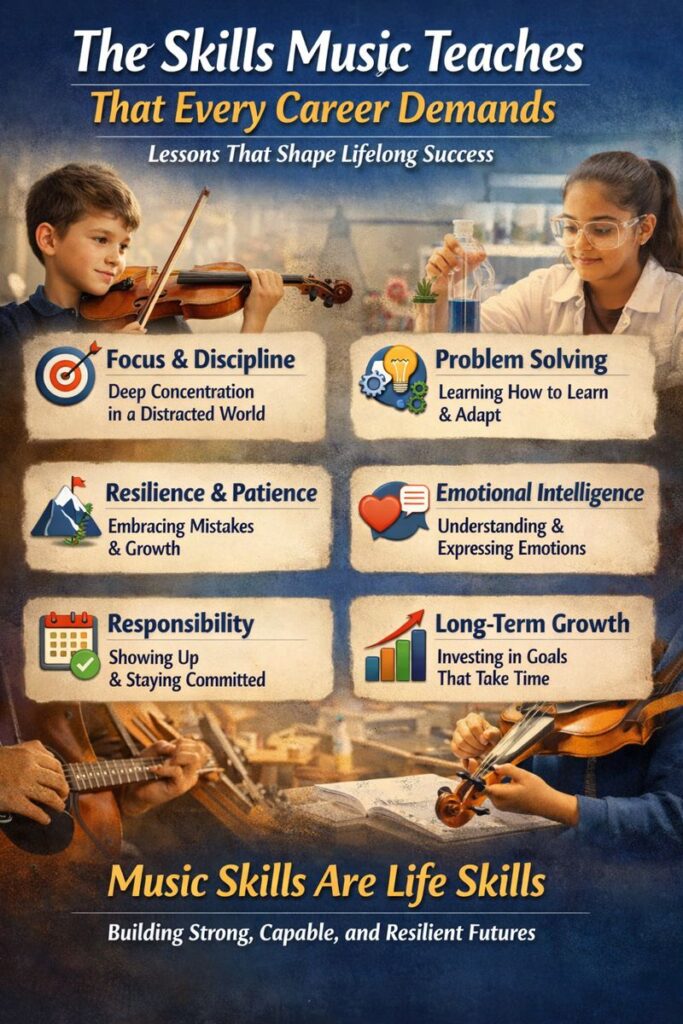
The Skills Music Teaches That Every Career Demands
When parents think about music lessons, a quiet question often lingers beneath the surface:
“If my child doesn’t become a professional musician, is this really worth the time and money?”
It’s a fair question—and an important one.
The truth is this: music education was never meant to be job training for musicians alone.
It is one of the most powerful skill-builders available for any child—regardless of the career they eventually choose.
In fact, many of the abilities employers now say are hardest to find are the very ones music develops naturally over time.
Let’s look at what music really teaches—and why these skills matter in every profession.
1. Focus in a Distracted World
Learning an instrument requires sustained attention.
Not just for minutes—but for years.
Students learn to:
-
Stay with a task even when it’s challenging
-
Resist instant gratification
-
Notice small details and correct them
-
Practice deep concentration in short, focused sessions
In a world built around notifications, scrolling, and constant interruption, this ability has become rare—and incredibly valuable.
Whether a child becomes a doctor, engineer, entrepreneur, or teacher, the capacity to focus deeply is a competitive advantage.
2. Learning How to Learn
Music is not memorization—it’s problem-solving.
Students constantly ask:
-
Why doesn’t this sound right yet?
-
What changed when I adjusted my hand position?
-
How can I practice this differently tomorrow?
Over time, students internalize a powerful lesson:
Progress comes from reflection, experimentation, and consistency—not shortcuts.
This “learning muscle” transfers directly to academics, professional training, and lifelong growth.
Many adults struggle not because they lack intelligence—but because they were never taught how to learn when something doesn’t come easily.
Music teaches that skill early.
3. Comfort With Striving for Goals Before Attaining Them
Music places students in a healthy relationship with failure.
Every musician sounds awkward at first.
Every new piece begins imperfectly.
Students learn:
-
Mistakes are information, not embarrassment
-
Growth requires patience
-
Improvement happens in layers, not leaps
This mindset is essential in careers that demand innovation, leadership, or creativity.
People who fear mistakes avoid growth.
People who understand the process move forward.
Music teaches children how to stay in the process.
4. Emotional Intelligence and Expression
Music develops something that doesn’t show up on report cards—but shows up everywhere else.
Students learn to:
-
Express emotion without words
-
Sense nuance and tone
-
Listen closely before responding
-
Communicate feeling, not just information
These skills are foundational to:
-
Leadership
-
Teamwork
-
Teaching
-
Counseling
-
Negotiation
-
Parenting
In many professions, technical skill gets you hired—but emotional intelligence determines how far you go.
5. Responsibility Without Pressure
Unlike many activities, music offers responsibility without artificial urgency.
There’s no buzzer.
No instant reward.
No forced competition.
Progress depends on:
-
Showing up
-
Doing the work
-
Taking ownership over time
Students learn that their effort matters, even when no one is watching.
That quiet sense of responsibility becomes part of who they are.
6. A Relationship With Long-Term Growth
Perhaps the most underrated skill music teaches is this:
Some things are worth doing even when the payoff is not immediate.
Music trains children to invest in something meaningful simply because it is meaningful.
That lesson stays with them for life.
So… Is Music “Worth It” If Your Child Isn’t a Professional?
If music were only valuable for producing musicians, it would indeed be a narrow investment.
But music education is not about producing performers.
It’s about shaping people who can:
-
Focus deeply
-
Learn independently
-
Handle challenge
-
Communicate meaningfully
-
Commit to growth over time
These are not “music skills.”
They are human skills—and every meaningful career depends on them.
At Maestro Musicians, we don’t promise that every child will become a musician.
We do promise that the process of learning music can help them become more capable, grounded, and resilient human beings.
And that is an outcome worth investing in.