
Music Unites Feeling and Structure — Emotion and Order
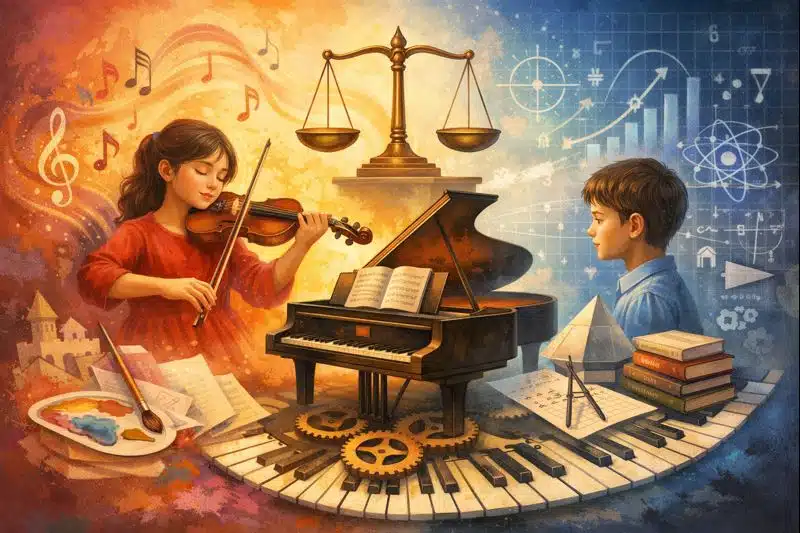
Most human activities develop either emotion or logic — but rarely both together.
Art, storytelling, and creative play awaken empathy, imagination, and feeling. They help children sense the inner world of emotion, but they often lack discipline, continuity, and structure.
Mathematics and science, on the other hand, train focus, logic, and precision. They cultivate discipline and problem-solving, but they often bypass emotion altogether.
Music is different.
Music is the rare human language where emotion and order meet — where feeling is shaped by structure, and structure is animated by feeling.
When a child learns a Bach minuet, something remarkable happens. Beneath the surface of notes and rhythms, the music is built on mathematical proportion, balance, and symmetry. Yet what the child experiences is not calculation — it is coherence. The phrases feel complete. The harmony feels grounded. The piece makes sense emotionally because it makes sense structurally.
And the child doesn’t learn this through explanation.
They learn it through their own nervous system.
Through repetition, listening, and refinement, the child experiences a profound truth: beauty can be built. Feeling does not arise from chaos, and order does not eliminate emotion. The two are not opposites — they are partners.
This is one of music’s quiet gifts.
A musical education trains children to live comfortably at the intersection of discipline and expression. It teaches patience without rigidity, freedom without disorder. Over time, students internalize the idea that meaning emerges when care, structure, and attention are applied consistently.
That lesson extends far beyond the practice room.
It becomes an education in harmony — not only musical harmony, but moral and personal harmony as well. The understanding that a well-ordered life can be deeply expressive, and that strong emotions can exist within thoughtful boundaries.
At Maestro Musicians, we believe this union of feeling and structure is one of music’s most lasting values. Long after specific notes are forgotten, the inner sense of balance remains — shaping how children think, feel, and move through the world.
And that may be music’s greatest legacy of all.
Looking for music lessons in Lexington, MA, Sharon, MA, or Cleveland, OH?