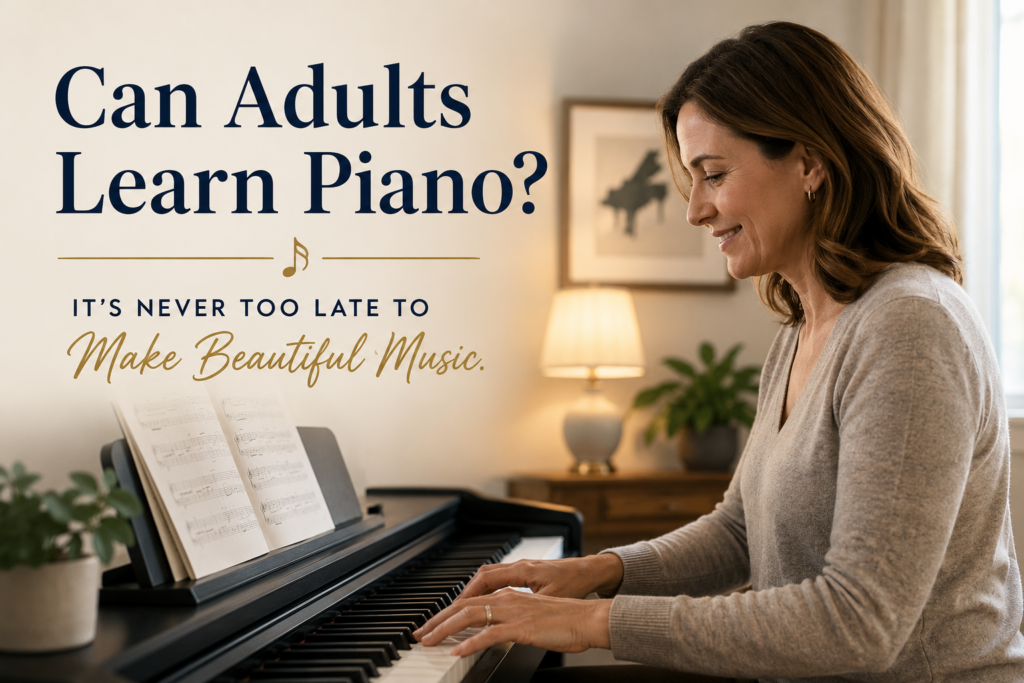
Can Adults Learn Piano?
Absolutely—And They May Have More Advantages Than They Think
Many adults have quietly wondered the same thing:
“Is it too late for me to learn piano?”
Perhaps you took a few lessons as a child and always wished you had continued. Maybe you’ve always loved music but never had the opportunity to learn. Or perhaps you’re looking for a meaningful hobby that challenges your mind and enriches your life.
The answer is encouraging:
Yes. Adults can absolutely learn piano.
At Maestro Musicians Academy, we’ve taught students from preschool age all the way through retirement. While adults learn differently than children, they are fully capable of becoming excellent pianists and discovering a lifelong love of music.
Why Adults Often Make Excellent Piano Students
Adults sometimes assume children have an advantage simply because they’re young. While children often absorb new information quickly, adults bring strengths that younger students simply don’t have.
1. Adults Choose to Be There
One of the greatest predictors of success is motivation.
Children sometimes practice because their parents ask them to.
Adults practice because they genuinely want to learn.
That internal motivation often leads to remarkable progress.
2. Adults Understand the “Why”
Adults tend to ask thoughtful questions:
- Why does this fingering work?
- Why is this chord written this way?
- Why should I practice slowly?
Understanding the reasoning behind musical concepts often leads to deeper learning rather than simple memorization.
3. Adults Have Better Discipline
Most adults have spent years developing habits of consistency through work, parenting, education, or other responsibilities.
Even practicing just 20–30 minutes a day consistently can produce excellent results over time.
Piano is less about talent than it is about regular, thoughtful practice.
Is It Harder to Learn Piano as an Adult?
There are certainly some differences.
Adults may not memorize music quite as quickly as young children, and they may be more self-conscious about making mistakes.
However, adults often compensate with:
- Better concentration
- Stronger analytical thinking
- Greater patience
- Better listening skills
- More effective practice habits
In many cases, adult beginners progress faster than people expect.
Common Myths About Adult Piano Lessons
“I’m too old.”
There is no age limit on learning music.
People begin piano in their 40s, 50s, 60s, and even their 80s.
The brain remains capable of learning throughout life.
“I have no musical talent.”
Talent is often misunderstood.
The vast majority of successful musicians became successful because they developed good habits over many years.
Learning piano is a skill—not a gift reserved for a select few.
“I’ll never be good enough.”
Good enough for what?
Not everyone wants to perform concertos with an orchestra.
Many adults simply want to:
- Play favorite songs
- Accompany family singing
- Play at church or synagogue
- Relax after work
- Challenge themselves intellectually
These are wonderful goals, and they are entirely achievable.
The Benefits Go Beyond Music
Learning piano doesn’t just teach notes and rhythms.
It develops qualities that enrich many areas of life.
Adults frequently tell us that piano lessons help them:
- Reduce stress
- Improve concentration
- Build confidence
- Strengthen memory
- Develop patience
- Experience a sense of accomplishment
Music also offers something increasingly rare in today’s world: focused, uninterrupted attention.
For thirty minutes, your mind isn’t checking email or scrolling through social media. It’s fully engaged in creating something beautiful.
What Should Adult Beginners Expect?
One of the biggest mistakes adults make is expecting to sound impressive within a few weeks.
Learning piano is much like learning a new language.
At first, you learn individual words.
Then simple sentences.
Eventually, you’re able to express yourself fluently.
Progress comes through consistent practice—not overnight breakthroughs.
The students who improve the most aren’t necessarily the most naturally gifted.
They’re the ones who keep showing up.
Should Adults Take Private Piano Lessons?
Private lessons offer several advantages for adult learners.
An experienced teacher can:
- Build a plan around your goals
- Correct technical problems before they become habits
- Choose music you’ll genuinely enjoy
- Keep you motivated
- Help you practice efficiently
Whether your goal is classical music, movie themes, jazz, worship music, or simply playing for your own enjoyment, individualized instruction allows you to progress at your own pace.
It’s Never Too Late to Begin
One of the most common things we hear from adult students is:
“I wish I had started years ago.”
The second-best time to begin is today.
Every accomplished pianist once sat down at the keyboard knowing almost nothing.
What mattered wasn’t when they started.
It was that they started.
If you’ve been thinking about learning piano, don’t let age hold you back.
Music has a remarkable way of enriching our lives at every stage, and your first lesson could be the beginning of a lifelong journey.
Ready to Learn Piano?
At Maestro Musicians Academy, we welcome adult beginners as well as experienced musicians looking to return to the piano after years away.
Our experienced teachers create personalized lessons in a supportive, encouraging environment, helping each student build confidence, develop strong technique, and discover the joy of making music.
Whether you’re pursuing a lifelong dream or simply looking for a rewarding new challenge, we’d love to help you begin.
Schedule a $49 trial lesson today and discover how rewarding learning piano can be—at any age.