

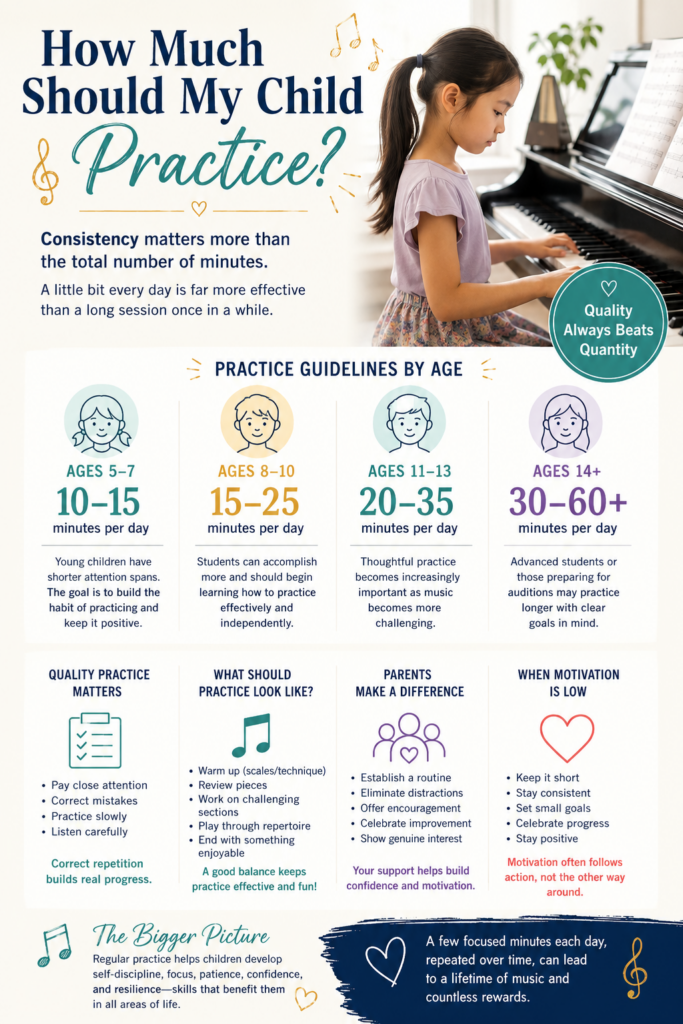
How Much Should My Child Practice?
One of the most common questions parents ask is:
“How much should my child be practicing?”
The answer may surprise you.
The goal is not to spend hours practicing. In fact, for most beginners, consistency matters far more than the total number of minutes.
A child who practices 15–20 minutes every day will usually make much faster progress than a child who practices two hours on Saturday and doesn’t touch the instrument for the rest of the week.
Music is much like learning a language. The brain develops through frequent, repeated exposure—not occasional marathon sessions.
Practice Guidelines by Age
While every child is different, these are good general guidelines.
Ages 5–7
10–15 minutes per day
Young children have shorter attention spans, and that’s perfectly normal. The goal is to build the habit of practicing, not to force long sessions.
Parents should remain nearby whenever possible to help establish a routine and keep practice positive.
Ages 8–10
15–25 minutes per day
At this stage, many students begin reading music more independently and can accomplish more during each practice session.
Rather than simply playing pieces from beginning to end, students should begin learning how to:
- Repeat difficult sections
- Practice slowly
- Listen carefully for accuracy
- Develop good technique
Ages 11–13
20–35 minutes per day
Students who practice consistently during these years often experience dramatic improvement.
As music becomes more challenging, thoughtful practice becomes increasingly important. Working carefully on difficult passages is much more valuable than simply playing through a piece multiple times.
Ages 14 and Older
30–60+ minutes per day
Teenagers who love music—or who are preparing for auditions, competitions, or examinations—may practice considerably longer.
However, even advanced students benefit from practicing with clear goals rather than simply watching the clock.
Quality Always Beats Quantity!
Many parents assume that more practice automatically produces better results.
Not necessarily.
Consider these two students:
Student A
- Practices 15 minutes every day
- Pays close attention
- Corrects mistakes
- Practices slowly when needed
Student B
- Practices one hour twice a week
- Rushes through pieces
- Repeats mistakes without fixing them
In most cases, Student A will make much faster progress.
Why?
Because the brain learns through correct repetition. Every time a student repeats something correctly, they strengthen those musical pathways. Repeating mistakes strengthens the mistakes instead.
What Should Practice Look Like?
A productive practice session usually includes several different activities.
For example:
- Warm up with scales or technical exercises
- Review pieces already learned
- Work carefully on challenging sections
- Play through current repertoire
- End with something enjoyable
Not every practice session needs to feel like work. Ending with a favorite piece helps students associate music with enjoyment instead of obligation.
Should Parents Help?
Especially for younger students, yes.
Parents do not need musical experience to make a tremendous difference.
You can help by:
- Establishing a regular practice time
- Eliminating distractions
- Offering encouragement
- Celebrating improvement rather than perfection
- Asking your child to perform something they learned
Children whose parents show genuine interest in their musical growth are much more likely to continue lessons long-term.
What If My Child Doesn’t Want to Practice?
This is completely normal.
Nearly every student goes through periods of low motivation.
The solution usually isn’t to lecture or punish. Instead:
- Keep practice sessions short.
- Maintain a consistent daily routine.
- Set small, achievable goals.
- Celebrate progress.
- Stay positive.
Motivation often follows action—not the other way around. Once children begin practicing regularly again, enjoyment usually returns.
The Bigger Picture
Learning an instrument teaches far more than music.
Regular practice helps children develop:
- Self-discipline
- Patience
- Focus
- Problem-solving skills
- Confidence
- Resilience
These qualities benefit students throughout school, college, and eventually their careers.
A child who learns to practice consistently is also learning how to tackle difficult challenges one small step at a time.
Final Thoughts
There is no magic number of minutes that guarantees success.
What’s far more important is creating a consistent habit of thoughtful practice.
A few focused minutes each day, repeated over months and years, often produce remarkable results.
At Maestro Musicians Academy, our teachers work closely with students and families to develop age-appropriate practice habits that encourage steady progress without overwhelming busy schedules. We believe music should be both challenging and enjoyable, helping students build skills—and confidence—that last a lifetime.