Is Learning Violin Harder than Piano?
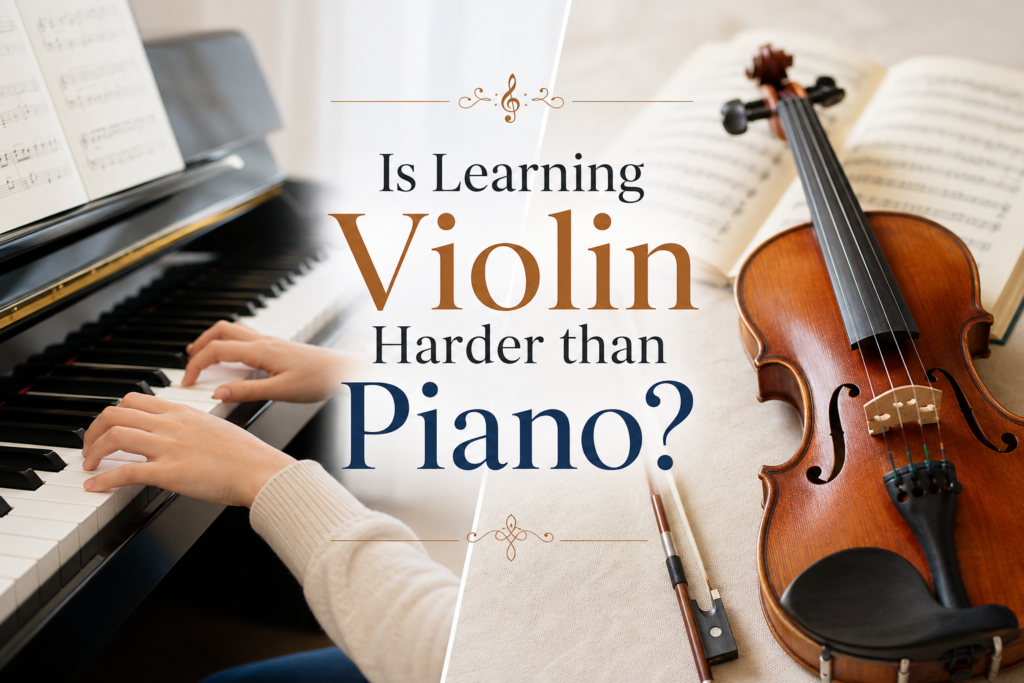
Is Learning Violin Harder than Piano?
If you’re trying to decide between piano and violin lessons, one of the first questions you’ll probably ask is:
“Which instrument is harder to learn?”
The honest answer is that the violin is generally more difficult to learn in the beginning, while the piano is easier to produce pleasant sounds on from day one. However, both instruments become incredibly rewarding—and incredibly challenging—as you progress.
Let’s look at why.
Why the Violin Is Usually Harder for Beginners
1. Producing a Beautiful Sound Takes Time
On a piano, pressing a key immediately produces the correct note.
On a violin, making a pleasant sound is an entirely different challenge. Beginners must learn how to:
- Hold the bow correctly
- Maintain consistent bow pressure
- Keep the bow straight
- Control bow speed
- Place the bow in the correct contact point between the bridge and fingerboard
Without these skills, even the correct notes can sound scratchy or squeaky.
This is perfectly normal—but it means beginners need patience.
2. There Are No Frets or Keys
Unlike a guitar, violin fingerboards have no frets to guide finger placement.
Every note must be placed with remarkable precision. Even being a few millimeters off can make the note sound noticeably out of tune.
Developing accurate intonation takes years of consistent practice and careful listening.
3. Both Hands Perform Completely Different Jobs
The violin requires intense coordination.
The left hand:
- Finds the correct notes
- Changes positions
- Creates vibrato
The right hand:
- Controls the bow
- Shapes tone
- Produces dynamics
- Creates rhythm and articulation
Both hands must work independently while remaining perfectly synchronized.
Why Piano Is Easier at First
Immediate Success
One of the biggest advantages of piano is that beginners can start playing recognizable melodies almost immediately.
Each key produces exactly one pitch, so students don’t have to worry about intonation.
This early success helps many children stay motivated.
Reading Music Is More Visual
The layout of the keyboard makes musical patterns easier to understand.
Students can literally see:
- High and low notes
- Half steps and whole steps
- Chords
- Scales
- Musical intervals
Many music theory concepts become easier to grasp because they’re physically represented on the keyboard.
But Piano Becomes Extremely Challenging Too
Some people assume piano is an “easy” instrument.
Professional pianists would strongly disagree.
As students advance, they face challenges such as:
- Playing multiple independent musical lines simultaneously
- Coordinating both hands at different rhythms
- Complex pedaling techniques
- Rapid scales and arpeggios
- Interpreting sophisticated classical repertoire
- Producing beautiful tone and musical phrasing
Masterpieces by composers like Frédéric Chopin, Franz Liszt, and Sergei Rachmaninoff are among the most technically demanding works ever written.
The Violin Has a Steeper Learning Curve
Many teachers describe the difference this way:
- Piano: easier to start, harder to master.
- Violin: harder to start, equally difficult to master.
The first six to twelve months of violin lessons often require more patience because students are learning how to create a beautiful sound before they can fully enjoy playing music.
Once those foundational skills develop, progress becomes much more rewarding.
Which Instrument Is Better for Children?
Both instruments offer tremendous educational benefits.
Piano may be a better choice if your child:
- Enjoys visual learning
- Wants quick early success
- Likes playing chords and accompanying songs
- Is interested in composing music
Violin may be a better choice if your child:
- Loves singing melodies
- Enjoys orchestral music
- Wants to play in youth orchestras
- Is patient and willing to work through early challenges
There is no universally “better” instrument—only the one that best matches your child’s interests and personality.
Can You Learn Both?
Absolutely.
Many musicians begin with piano because it provides a strong foundation in music reading, rhythm, harmony, and theory.
Others start with violin and later add piano as a complementary instrument.
Learning both can create exceptionally well-rounded musicianship.
The Most Important Factor Isn’t Difficulty
Parents often worry about choosing the “easier” instrument.
In reality, motivation matters far more than difficulty.
A child who is excited about playing the violin will often practice more consistently than a child who was pushed toward piano simply because it seemed easier.
Likewise, a child who loves the piano will thrive despite increasingly challenging repertoire.
The best instrument is the one your child is genuinely excited to play.
Frequently Asked Questions
Is violin harder than piano for adults?
Generally, yes. Adults often find producing a beautiful violin tone and developing accurate intonation more challenging than beginning piano. However, adults can succeed on either instrument with regular practice and quality instruction.
How long does it take to sound good on violin?
Most beginners start producing a noticeably pleasant sound after several months of consistent practice. More refined tone and intonation continue to develop over many years.
Is piano easier to learn by yourself?
Piano is generally more self-guided than violin because pressing the correct keys produces the correct pitches. Even so, lessons help students build proper technique and avoid habits that become difficult to change later.
Should my child start with piano before violin?
Not necessarily. While piano provides an excellent musical foundation, many successful violinists began directly on the violin. The right choice depends on your child’s interests, goals, and personality.
Ready to Begin Your Musical Journey?
Whether your child dreams of performing beautiful violin concertos or playing favorite songs on the piano, the right teacher can make all the difference.
At Maestro Musicians Academy, our experienced instructors help students of all ages build strong technique, confidence, and a lifelong love of music through personalized private lessons in both piano and violin.
Contact us today to schedule a trial lesson and discover which instrument is the perfect fit for your family.