Music Bypasses Language — It Speaks Directly to the Soul
Words are powerful.
But words also divide.
They carry definitions, arguments, assumptions, and limits. Two people can hear the same sentence and walk away with completely different meanings.
Music works differently.
Before a child has words for love, grief, or awe, they already know what those feelings are—because they’ve felt them through sound. A lullaby. A minor chord. A swelling phrase that somehow feels bigger than the room it’s in.
Music doesn’t tell us what to feel.
It creates the space in which feeling becomes possible.
That’s why music reaches people where explanations fail. You don’t need a shared language, background, or belief system to be moved by a melody.
You simply need to listen.
We see this all the time.
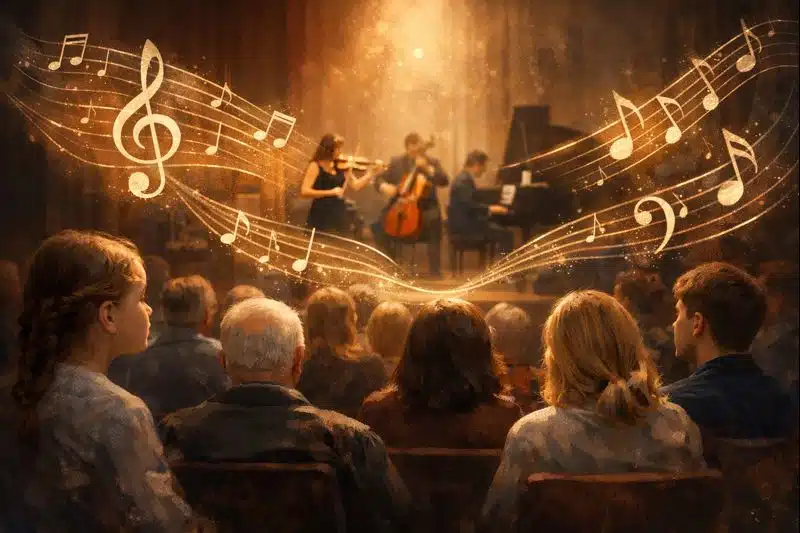
People who disagree on nearly everything can sit in the same room, silently affected by the same performance. No debate. No persuasion. Just presence.
Just connection. For a few minutes, differences soften. Something human takes over.
In a world that feels increasingly fragmented—where communication is constant but connection is rare—music remains one of the last truly universal languages. It doesn’t argue. It doesn’t demand. It invites.
For children, this matters deeply.
Music gives them access to emotional understanding long before they can articulate it. It teaches them to notice, to feel, to stay with something that unfolds slowly. It helps them develop an inner life—one that isn’t dependent on screens, words, or instant answers.
At Maestro Musicians, we believe this is one of music’s greatest gifts.
Yes, children learn technique. Yes, they develop discipline and skill. But more importantly, they learn how to listen—to themselves and to others. They learn that expression doesn’t always need explanation. That meaning can be felt, not just spoken.
Music reminds us that at our core, we are more alike than different.
And sometimes, the most important conversations don’t happen in words at all.
Looking for music lessons in Lexington, MA, Sharon, MA, or Cleveland, OH?