
How Music Lessons Boost Focus, Memory, and Math Skills in Kids
How Music Boosts Focus, Memory, and Math Skills — Without Feeling Like Homework
Many parents want their children to develop strong focus, memory, and academic skills. But they also worry about overscheduling and adding more pressure after a long school day.
That’s one of the remarkable things about learning music: it strengthens the brain in powerful ways while still feeling creative, expressive, and fun.
At Maestro Musicians Academy, we know that children gain discipline and focus and music lessons help with school, too!
This connection between music and cognitive development is well documented—and it happens naturally through the process of learning an instrument.
Let’s explore why.
Music Teaches Focus in a Way That Feels Natural
When a child practices an instrument, they are doing something that modern life rarely demands: sustained attention.
They must listen carefully, watch their hands, follow patterns, and adjust in real time. Even a short piece of music requires concentration from beginning to end.
Unlike worksheets or memorization drills, music engages multiple senses at once:
-
Listening
-
Physical coordination
-
Pattern recognition
-
Emotional expression
Because it’s engaging and creative, children often stay focused far longer than they would on traditional academic tasks.
Over time, this ability to concentrate transfers into other areas of life, including schoolwork.
Music Strengthens Memory Through Repetition and Pattern
Learning music naturally builds memory skills.
Think about what happens when a child learns a new piece:
-
They remember rhythms
-
They recall finger patterns
-
They anticipate what comes next in the music
-
They internalize structure and form
Instead of memorizing isolated facts, they learn patterns and sequences, which is exactly how the brain prefers to learn.
This type of memory training is powerful because it combines:
-
auditory memory
-
physical (muscle) memory
-
visual memory
-
emotional engagement
When multiple parts of the brain work together, retention becomes much stronger.
Music and Math Share the Same Brain Pathways
It’s no coincidence that many musicians are strong in mathematics.
Music is full of mathematical relationships:
-
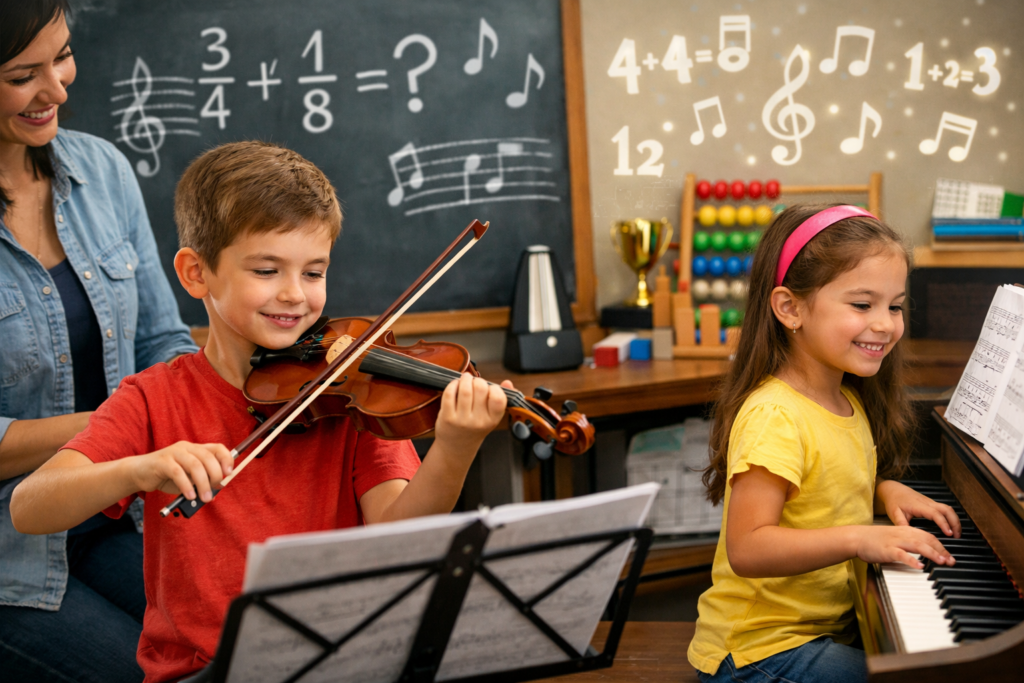
Rhythms are fractions (quarter notes, eighth notes)
-
Measures involve counting and grouping
-
Musical phrases follow patterns and symmetry
-
Tempo requires precise timing
But children don’t experience this as “math.”
They experience it as music-making.
In other words, they absorb mathematical thinking through sound and movement rather than through abstract numbers on a page.
Music Builds Discipline Without Pressure
One of the biggest challenges parents face today is motivating children to practice difficult skills.
Music solves this problem in an elegant way.
When a child learns a piece of music, they experience small but meaningful victories:
-
Mastering a tricky rhythm
-
Playing a phrase smoothly
-
Performing at a recital
These moments create motivation from within, rather than pressure from outside.
Over time, children begin to understand an important life lesson:
Progress happens through consistent effort.
This mindset carries into academics, sports, and other activities.
The Hidden Benefit: Confidence
Perhaps the most important benefit of music lessons isn’t academic at all.
It’s confidence.
Standing on stage at a recital, playing for family and friends, and hearing applause after working hard on a piece gives children a powerful sense of accomplishment.
They learn that they can take on challenges and succeed.
That confidence often carries into school, friendships, and future opportunities.
More Than Just Music Lessons
At Maestro Musicians Academy, our goal isn’t simply to teach notes and rhythms.
We believe music education should help children grow as thinkers, learners, and individuals.
Through mentorship, performance opportunities, and a supportive environment, students develop skills that stay with them for life.
Yes, they learn music.
But they also learn how to focus, how to persevere, and how to express themselves.
And unlike homework, they usually enjoy the journey along the way.
✔ Interested in helping your child experience the benefits of music?
Learn more about lessons at Maestro Musicians Academy or schedule a trial lesson to get started.
Looking for music lessons in Lexington, MA, Sharon, MA, or Cleveland, OH?