
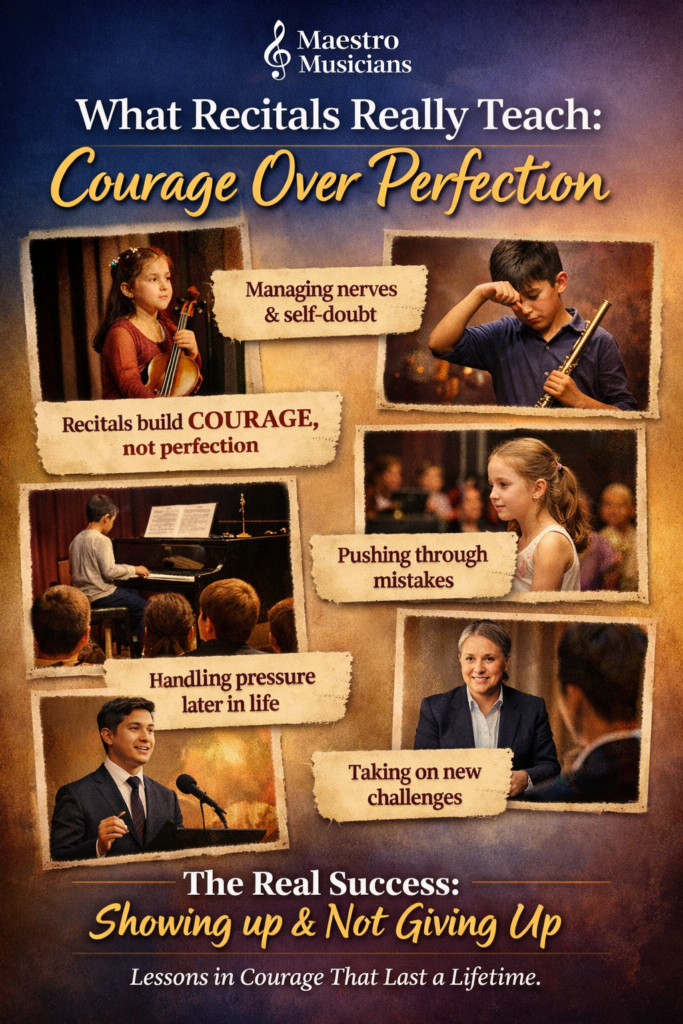
What Recitals Really Teach: Courage Over Perfection
If you’ve ever watched your child prepare for a music recital, you’ve probably seen a mix of emotions:
Excitement.
Nervousness.
Resistance.
Even fear.
And as a parent, it’s natural to wonder:
“Is this really worth it?”
After all, most children won’t become professional musicians.
So why put them through the pressure of performing?
Here’s the truth:
Recitals aren’t about creating performers.
They’re about building courage.
The Hidden Purpose of a Recital
From the outside, a recital looks simple:
A child walks on stage.
They play a piece.
They bow.
Applause.
But internally, something much deeper is happening.
Your child is learning to:
- Do something difficult in front of others
- Manage nerves and self-doubt
- Stay focused under pressure
- Finish what they started—even when it’s uncomfortable
These are not “music skills.”
These are life skills.
Why Perfection Is the Wrong Goal
Many children (and parents) walk into recitals thinking:
“It has to be perfect.”
But that mindset is exactly what holds kids back.
Because when perfection becomes the goal:
- Mistakes feel like failure
- Fear increases
- Kids become hesitant instead of expressive
And over time, they may want to quit—not because they don’t like music, but because they don’t like the pressure.
At Maestro Musicians, we believe something different:
The goal is not perfection.
The goal is showing up.
What Courage Looks Like (Especially for Kids)
Courage doesn’t look like confidence at first.
It looks like:
- Taking a deep breath before starting
- Hands shaking slightly on the first note
- Pushing through even after a small mistake
- Finishing the piece anyway
That moment—when a child continues instead of stopping—
That’s the win.
Not the flawless performance.
Not the loudest applause.
But the decision to keep going.
Why This Matters Beyond Music
Fast forward 10–15 years.
Your child may not remember every piece they played.
But they will remember what it felt like to:
- Stand up and do something hard
- Work toward a long-term goal
- Handle pressure without quitting
And those experiences show up later in life:
- Speaking in front of a class
- Interviewing for a job
- Presenting an idea
- Taking risks when it matters
Recitals are one of the safest places a child can learn to be brave.
A Different Way to Measure Success
After your child’s next recital, try this:
Instead of asking:
- “Did you make any mistakes?”
Ask:
- “Were you nervous—and did you do it anyway?”
- “What part are you proud of?”
- “What felt easier than last time?”
Because success isn’t:
✔ Playing perfectly
✔ Avoiding mistakes
It’s:
✔ Showing up
✔ Following through
✔ Growing a little each time