

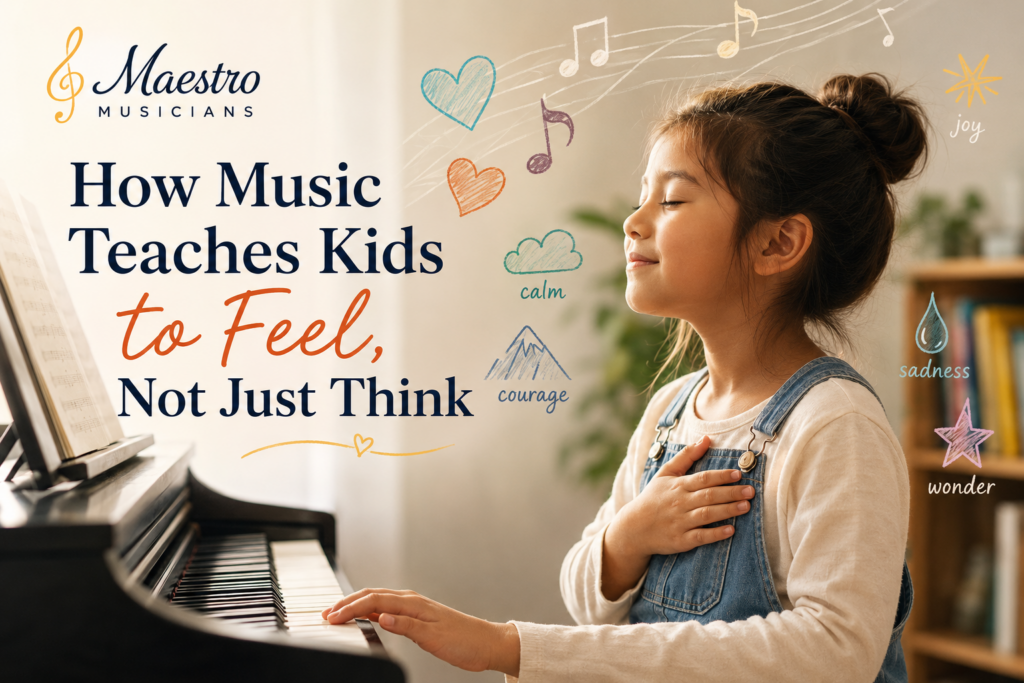
How Music Teaches Kids to Feel, Not Just Think
As parents, we spend a lot of time helping our children learn how to think.
We teach them math so they can solve problems. We encourage reading so they can understand ideas. We celebrate good grades because they reflect knowledge and effort.
But there is another part of being human that often receives less attention:
Learning how to feel.
Not simply experiencing emotions, but recognizing them, expressing them, and responding to them in healthy ways.
This is one of the hidden gifts of music education.
Music Gives Children a Safe Place to Experience Emotion
Children don’t always have the words to explain what’s happening inside them.
They may feel excitement before a big event, disappointment after a difficult day, frustration when something doesn’t go their way, or sadness they don’t fully understand.
Music provides an outlet.
A child playing a gentle melody on the piano learns that softness can communicate tenderness. A violinist discovers how changing the speed and weight of the bow can express longing, joy, or intensity. Singers learn that the same words can carry entirely different meanings depending on how they are delivered.
In music lessons, emotions become something that can be explored rather than avoided.
Beyond “Happy” and “Sad”
Children often describe emotions in broad categories.
“I’m happy.”
“I’m mad.”
“I’m sad.”
Music teaches nuance.
A piece might sound hopeful yet uncertain. Another may feel triumphant after struggle. One melody can carry both nostalgia and gratitude at the same time.
As students interpret music, they begin to recognize that emotions are complex. Life is rarely one thing or another.
This emotional vocabulary helps children better understand themselves and the people around them.
Empathy Through Art
When students play music written by composers from different times and cultures, they are invited into another person’s experience.
What was this composer trying to say?
Why does this phrase sound like a question?
Why does this section feel restless?
To answer these questions, students practice empathy. They learn to step outside of themselves and consider another person’s perspective.
In a world that often rewards quick reactions and snap judgments, empathy is a skill worth developing.
Music Teaches Children to Stay With Difficult Feelings
Learning an instrument can be deeply rewarding, but it is not always easy.
There are wrong notes.
Pieces that feel impossible.
Recitals that bring butterflies to the stomach.
Moments of disappointment.
Music teaches children that uncomfortable feelings do not have to be feared.
They can feel nervous and still perform.
They can feel frustrated and continue practicing.
They can feel discouraged and return tomorrow.
Over time, students develop emotional resilience—the ability to tolerate discomfort without giving up.
That lesson reaches far beyond the practice room.
Feeling Is Not the Opposite of Thinking
Some people imagine emotions and intellect as opposites.
But healthy adults need both.
We want our children to make wise decisions while also caring deeply about others. We want them to solve problems and build meaningful relationships. We want them to think critically without losing their humanity.
Music brings these worlds together.
A student reads rhythms with precision while expressing beauty.
They analyze structure while communicating emotion.
They practice discipline while developing sensitivity.
They learn that the strongest people are not those who ignore their feelings, but those who understand them.
The Goal Isn’t to Raise Professional Musicians
Most children who study music will not become concert performers.
And that’s perfectly okay.
The value of music was never limited to producing professionals.
Music helps children become attentive listeners, compassionate friends, thoughtful leaders, and emotionally healthy adults.
It teaches them that feelings matter.
That beauty matters.
That what happens inside us deserves expression, understanding, and care.
In a world increasingly focused on efficiency, performance, and measurable outcomes, perhaps one of music’s greatest gifts is this:
It reminds our children that they are not machines designed only to think.
They are human beings learning how to feel.
And that may be one of the most important lessons of all.